Ever since it was founded, the CAYC (Centro de Arte y Comunicación), helmed by the cultural promoter, artist, and businessman Jorge Glusberg, was intended as an interdisciplinary space where an experimental art movement could flourish. The establishment of collaborative networks connecting local and international artists and critics played an important role in this process. In addition to the exhibitions, a program of different activities exposed attendees to the latest in art and scientific thinking. According to Glusberg, the coordination between theoretical thinking and artistic practice was an essential part of social change.
Architecture was a basic component of the CAYC’s interdisciplinary approach. In its early years, the center became affiliated with the Fundación de Investigación Interdisciplinaria (Foundation for Interdisciplinary Research), an organization that welcomed a group of dissident professors from the Facultad de Arquitectura y Ciencias Exactas at the Universidad de Buenos Aires following the forced occupation of universities that took place after the coup d’état in 1966. That earlier affiliation left an indelible mark on various aspects of the CAYC’s operations, such as its approach to many of its initiatives as “projects;” the use of heliographic copies (a technique usually used for copying blueprints) in its exhibitions; the center’s collaboration with the industrial sector in exhibitions and contests; and the presence of several artist-architects among the founders of the Grupo de los Trece.
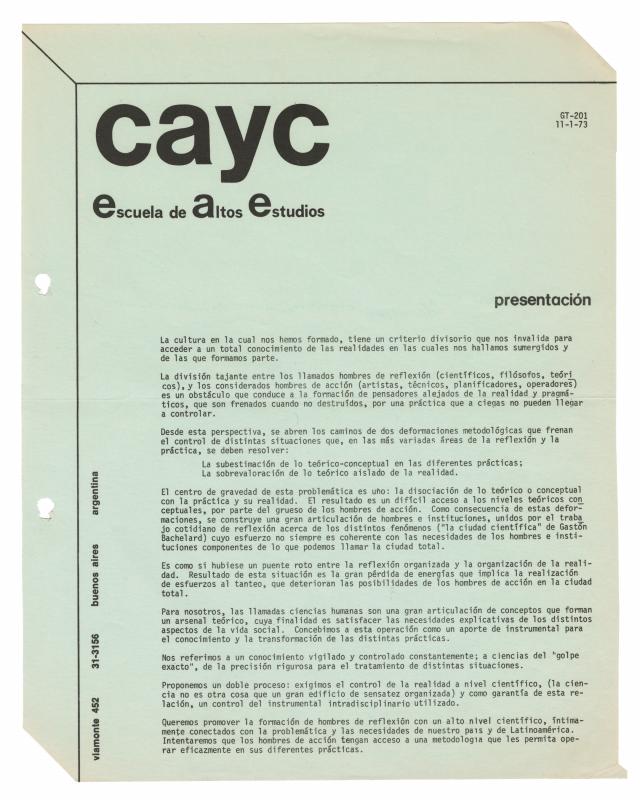
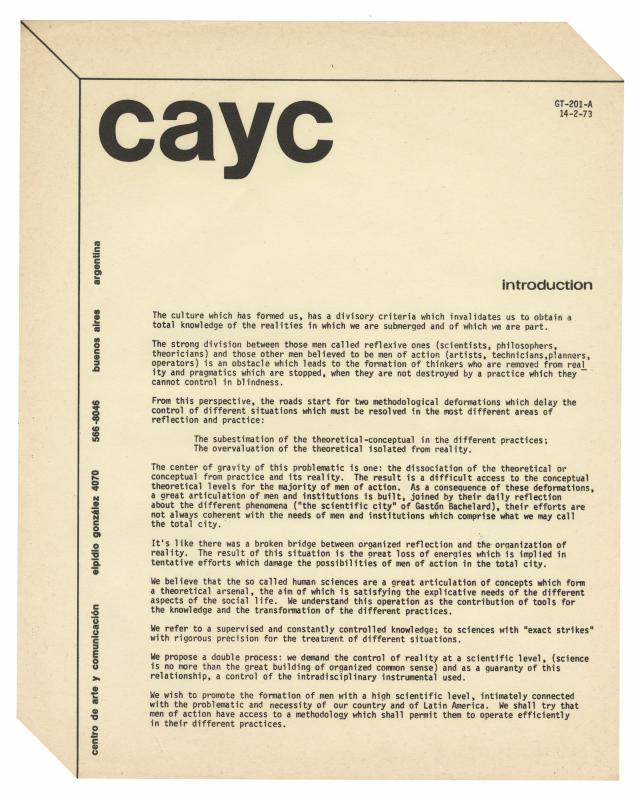
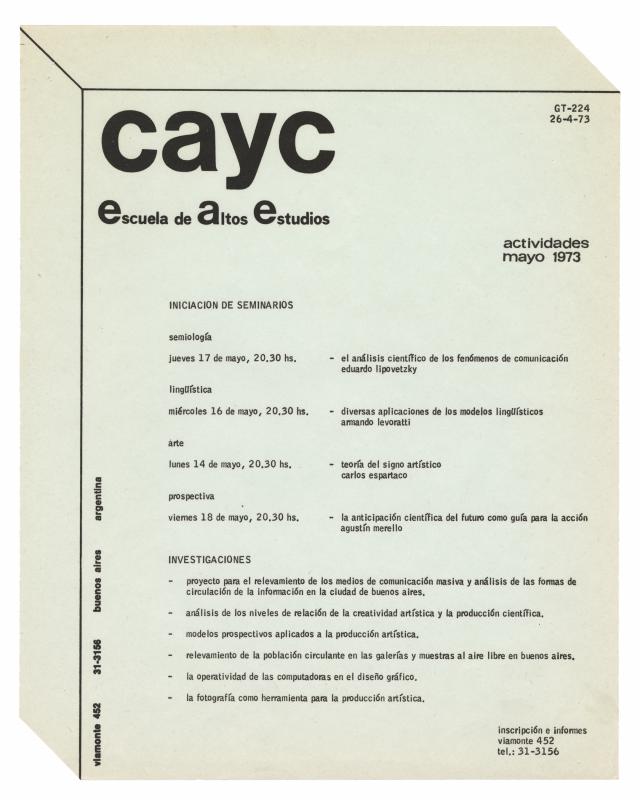
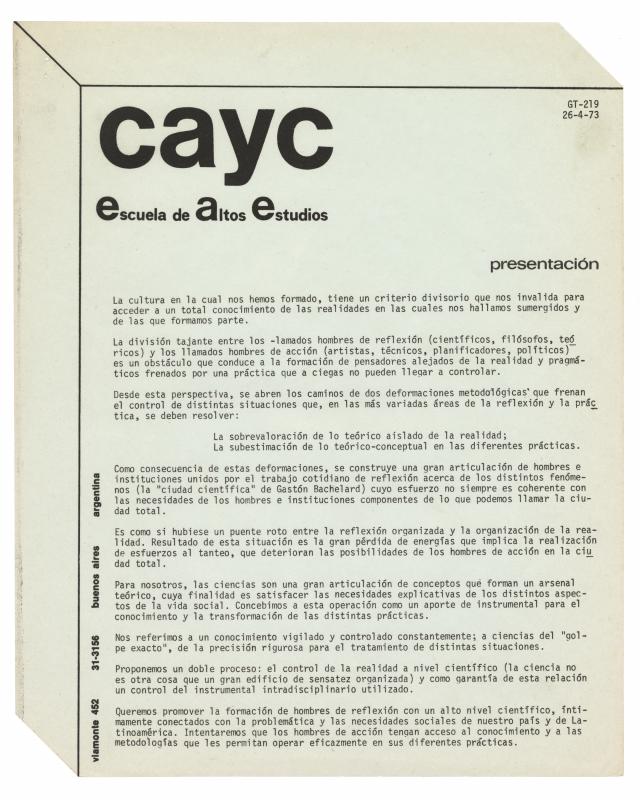
In its early years the center organized a variety of activities with intellectuals that contributed to the circulation of ideas from different disciplines (analytical philosophy, mathematical logic, epistemological problems, psychology, semiotics, and linguistics), which had been excluded from official circles. The center’s interest led to the creation of the Escuela de Altos Estudios (EAE, the School of Advanced Studies) in early 1973. The objectives described in the newsletters that announced the school’s creation at the CAYC (GT-201; doc. no. 1478752, GT-201- A; doc. no. 1478753, GT-224; doc. no. 1478771, GT-219; doc. no. 1478755) were apparent in the activities organized by the EAE (both technical and interdisciplinary), as well as in the art produced by artists associated with the center.
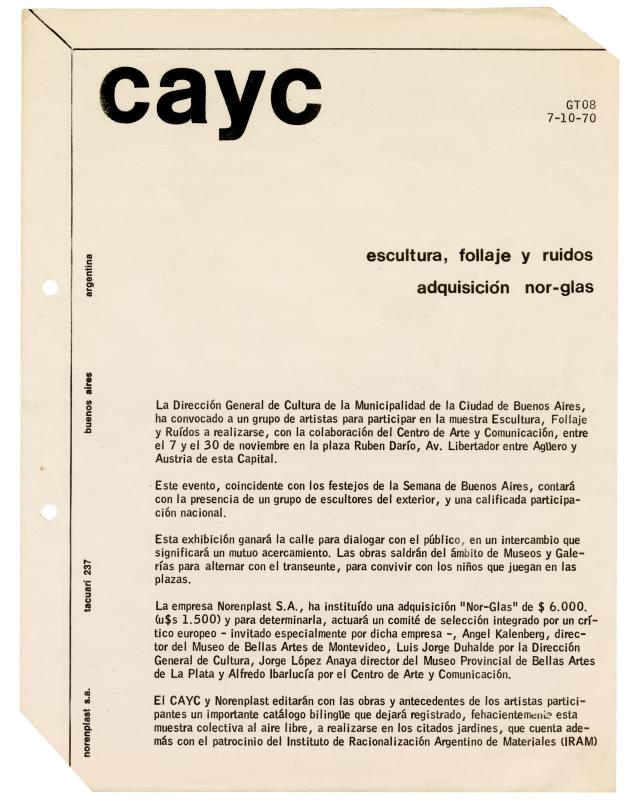
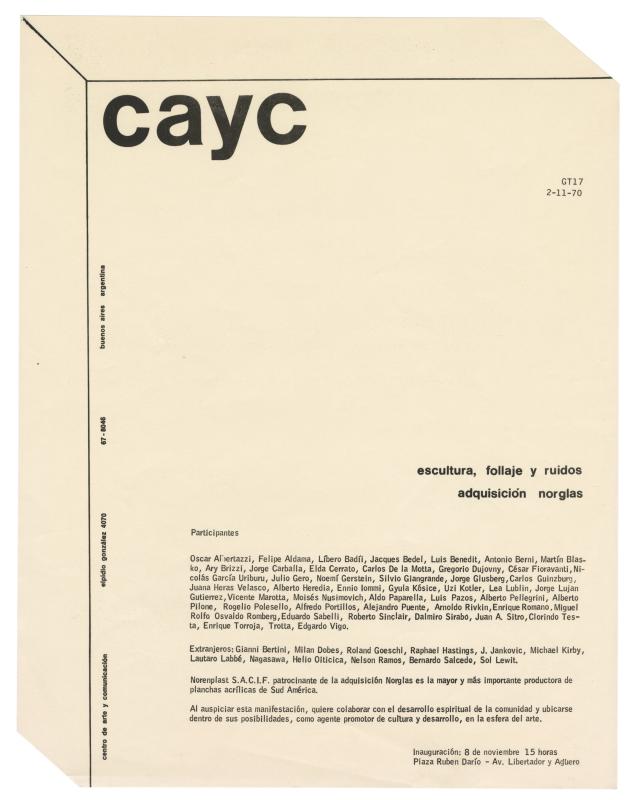
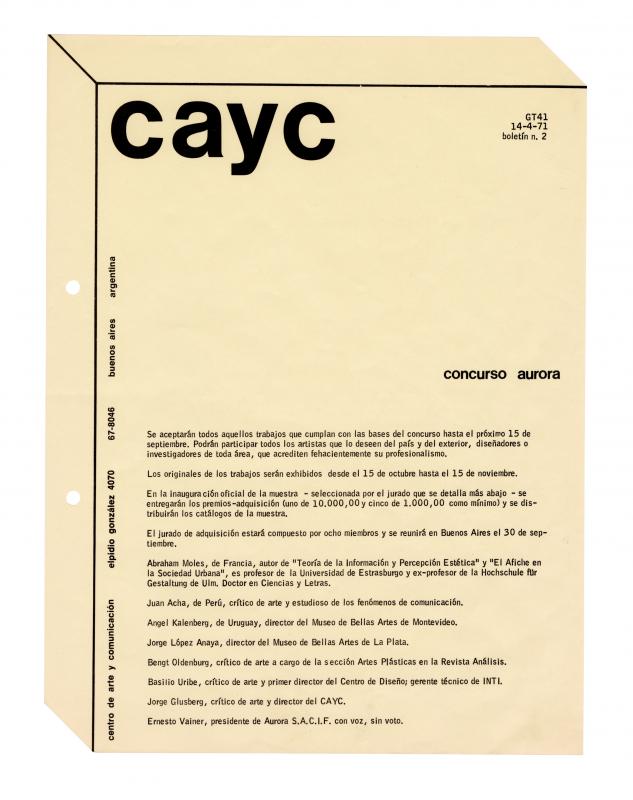
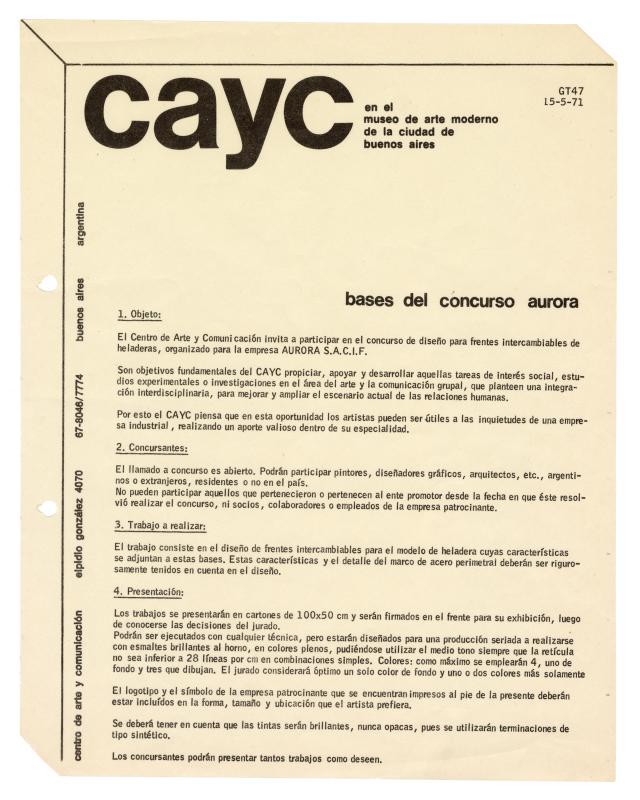
In his lecture, the architect Luis Lentini—a member of the CAYC’s Área de Arquitectura—presented a critical, interdisciplinary review of the history and practice of architecture, focusing on semiotics and the sociology of culture. Initiatives of this kind were conceived as opportunities for exposure and exchange, which contributed to the development of disciplines that were thought to have been ignored or overlooked in Argentina during the 1970s and, originally, since the takeover of the universities following the military coup in 1966. Courses, exhibitions, and competitions of this type frequently enjoyed the support of companies engaged in the production and marketing of industrial products. A case in point was the involvement of Noren Plast S.A. (a supplier of plastic materials) in the exhibition Escultura, follaje y ruidos in 1970 (GT-08; doc. no. 1477957, GT-17; doc. no. 1477959), or the competition organized by the Aurora home appliance company in 1971 (GT-41; doc. no. 1478063, GT-42; doc. no. 1478064, GT-47; doc. no. 1478075). In this case, the sponsors were the Sociedad Central de Arquitectos and Modulor S.A., a firm that sold lighting fixtures and was owned by the director of the CAYC.