Ever since it was founded, the CAYC (Centro de Arte y Comunicación), helmed by the cultural promoter, artist, and businessman Jorge Glusberg, was intended as an interdisciplinary space where an experimental art movement could flourish. The establishment of collaborative networks connecting local and international artists and critics played an important role in this process. In addition to the exhibitions, a program of different activities exposed attendees to the latest in art and scientific thinking.
The CAYC emerged as an outgrowth of the Fundación de Investigación Interdisciplinaria, a group of dissident professors at the Universidad de Buenos Aires Facultad de Arquitectura y Ciencias Exactas in the context of the military dictatorship under General Juan Carlos Onganía. The military had seized that department of the university in June 1966 in what came to be known as “La Noche de los Bastones Largos." In its early years, the CAYC organized activities with intellectuals to enable the circulation of ideas from an array of disciplines excluded from the mainstream, fields like analytic philosophy, mathematics and logic, epistemology, psychology, semiotics, and linguistics. The articulation of theory and artistic practice was, in Glusberg’s proposal, crucial to social change.
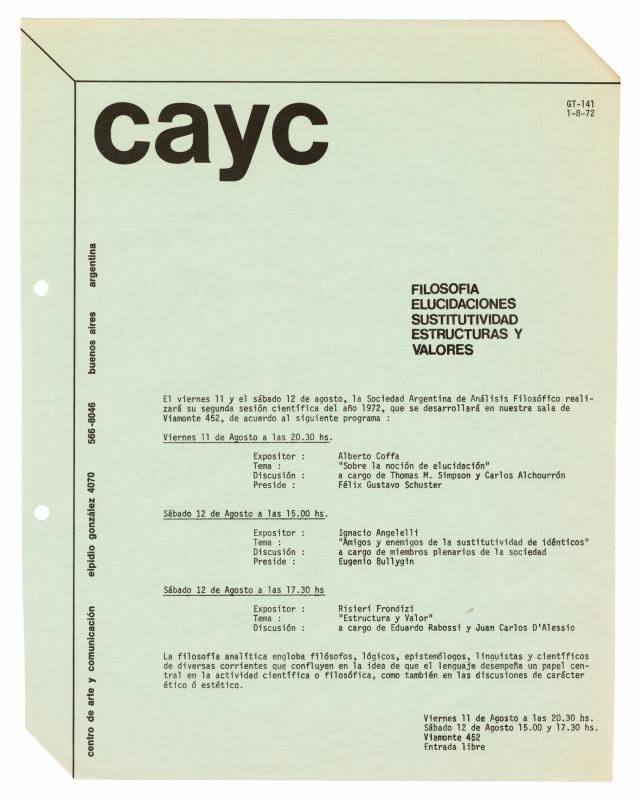
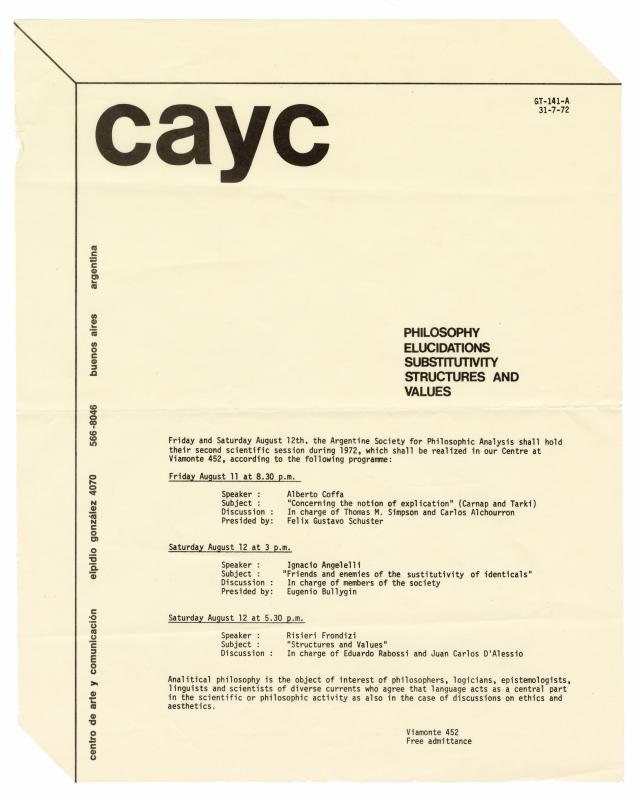
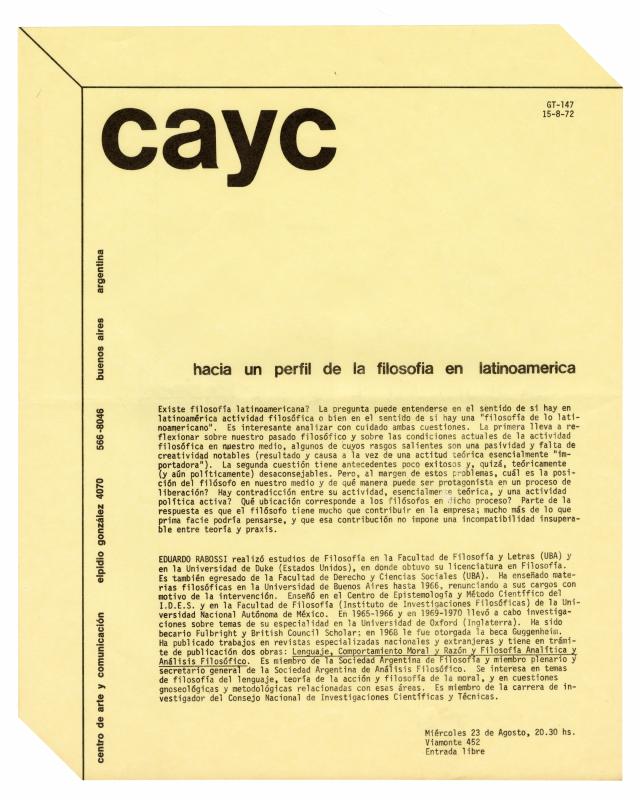
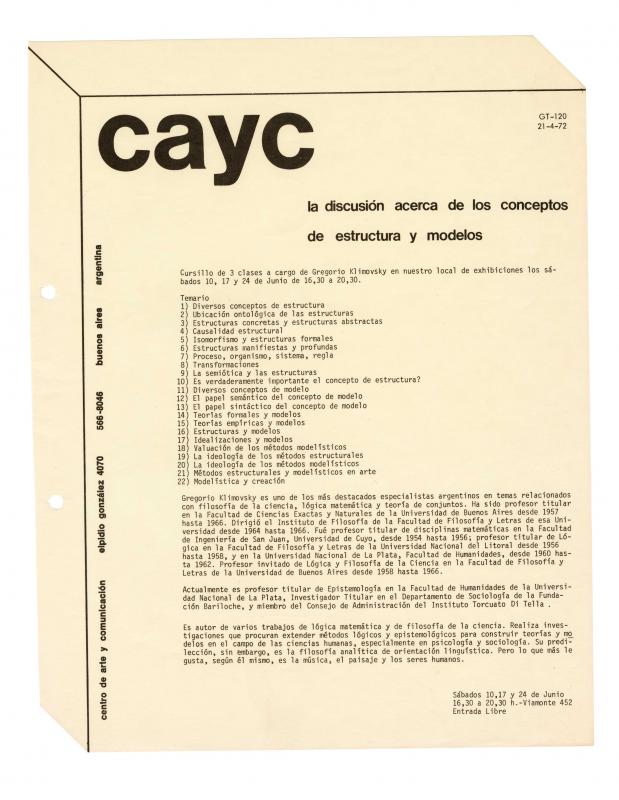
That interest was reflected in the creation of the EAE in early 1973. While the CAYC had organized encounters of this sort prior to its incorporation of the EAE—some of them in conjunction with the Sociedad Argentina de Análisis Filosófico (SADAF) (see GT-141; doc. no. 1478780, GT-141-A; doc. no. 1478781, GT-147; doc. no. 1478783, GT-120 [la lógica y el método hipotético deductive]; doc. no. 1478803)—the space for the circulation of ideas was formalized when the EAE joined the CAYC. From the beginning, academics and intellectuals from a wide range of fields participated in those events. This press release announcing the aims of the collaboration between the EAE and the CAYC predates the launch, in May 1973, of their shared activities, specifically seminars and lectures. Political activism makes itself felt in language of this text, released soon before the presidential elections of March 1973 that would bring to an end seven years of military dictatorship under Onganía, then Levingston, and then Lanusse and eighteen years of a ban on the Peronist Party.