April 10, 2026
By Angela Pastorelli-Sosa, Postdoctoral Fellow in Latinx Art
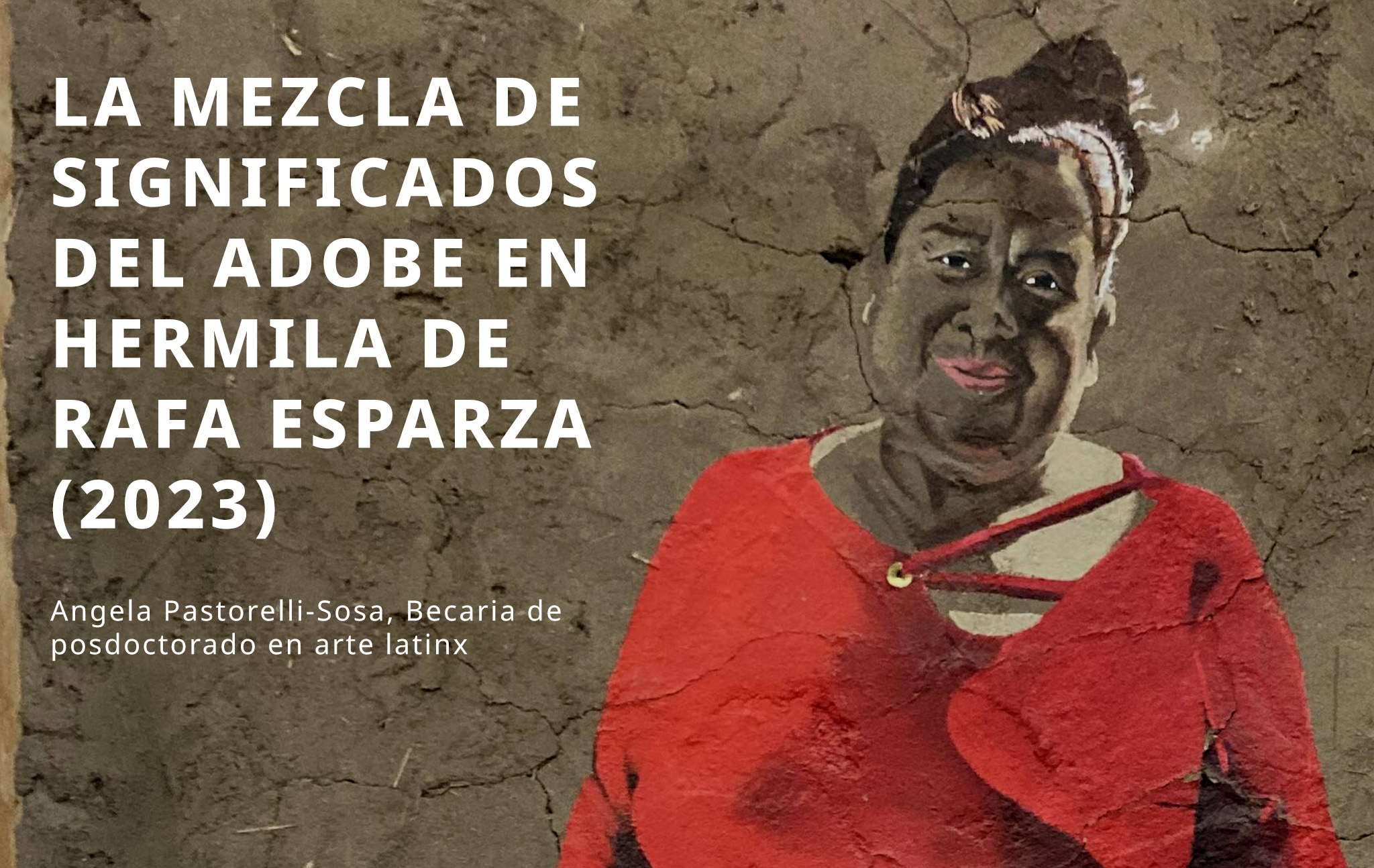
In 2024, the MFAH acquired Rafa Esparza’s work, Hermila (2023), a painted portrait of the artist’s mother on an adobe panel, which depicts her walking toward the viewer with a warm smile and a machete in her hand. The artist worked from a photograph that he took of his mother at their family home in Pasadena, California. In Hermila, the adobe’s organic materials render the figure’s brown complexion, while the artist uses acrylic paint to depict her clothing and sunlight illuminating his mother’s right side, thus recreating their sunny day in his family garden. Adobe is a traditional building material made from sun-dried earth—specifically a mixture of clay, sand, silt, and water, and often bound with straw or grass.
It is mostly commonly associated with earthen houses in the U.S. Southwest and pre-contact murals and frescos found in parts of Mexico. As curatorial and conservation fellows in the Aquí Estamos!: Latinx Art at the MFAH initiative, Camille Ferrer and I are researching the work of contemporary Latinx artists in our collection. This blog post examines Esparza’s decision to use the historical material, adobe, and how his work draws on Chicano muralism.
Esparza, a queer Chicano multidisciplinary artist, learned to craft adobe bricks from his father in 2008, who had been a brickmaker in Mexico before migrating to the U.S. Esparza asked his father to teach him brickmaking as a way to repair their relationship, which had become strained when he came out to his family.[i] Esparza recalled that, although they rarely spoke, they slowly began to heal their relationship through this shared labor. The artist realized that he was inheriting embodied, generational knowledge rooted in the regional and indigenous building traditions of Mexico where his father grew up, thus forging closer ties with his ancestral homeland.
Esparza has been working with adobe for over ten years, and while many of his works have included building structures or covering gallery floors with bricks for large-scale installations or as part of performances, Hermila is part of a series of life size portraits painted on adobe panels. These works were originally exhibited in the solo exhibition, Camino, in New York in 2023. The exhibition featured sculptures, paintings, and earthen elements that responded to urban development in Los Angeles, specifically the construction of the Arroyo Seco section of the 110 Freeway completed in 1940.[ii] While initially championed as an innovation in vehicular roadway systems and mobility, the freeway, as Esparza reminds us, divided Los Angeles and impacted working-class communities of color by making the city less walkable.[iii] This mid-20th century urban-planning model was adapted throughout the country, resulting in an almost standardized approach to dividing communities by way of freeway construction and redlining.
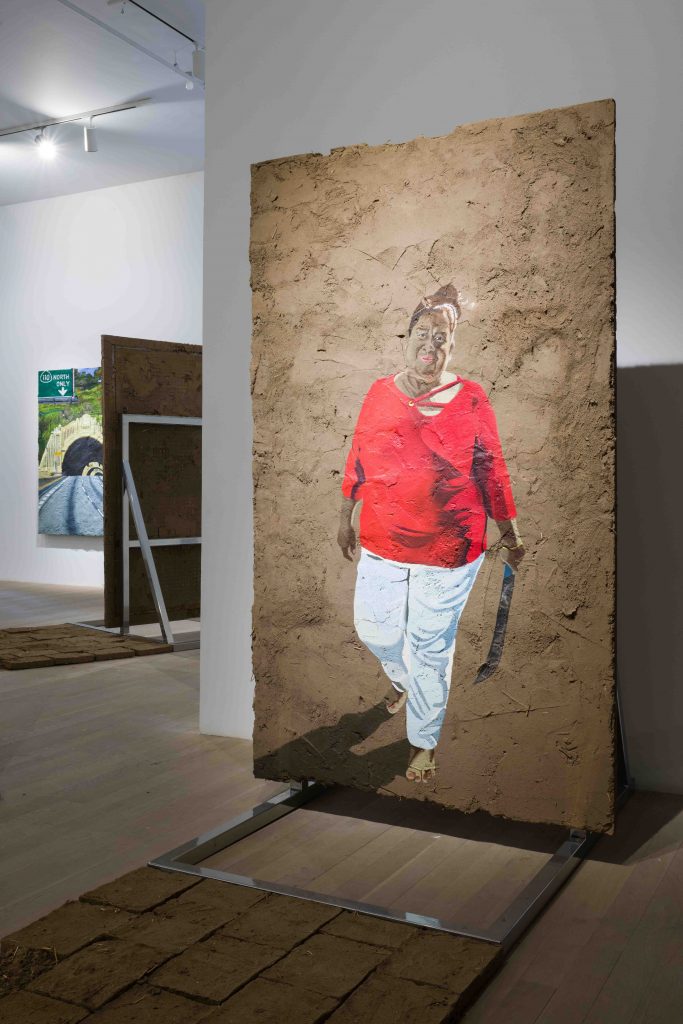
Adobe materially anchored the exhibition, serving as an organic counterpoint to the inorganic asphalt and multiple landscapes of the freeway throughout the exhibition. Esparza sought to underscore the idea of walkable cities by placing adobe bricks throughout the exhibition and arranging them into pathways that linked the portraits. Camino (which in Spanish means “road” or “I walk”) envisioned a space where people could have direct access to earthen, unpaved ground. Rising over seven feet tall, the adobe panel portraits also command a powerful sculptural presence, taking up space within the white cube. Esparza provided insight into his process in an interview with MFAH’s curatorial and conservation staff in 2024,
For every portrait I made, all of the photos I worked directly from, I asked all of the people I was photographing if they would remove their shoes. So that everyone would be figured within an adobe panel barefoot, literally grounding them on an earthen surface. Bringing the panels off the wall to stand in the round was a decision that integrated them into the installation we built. While considering all of the structural components of the panels that help sustain the adobe, I realized the potential they have add an architectural presence in space. So, all of the panels are the same height. They stand in the round and you could experience them as a full object but also have a one-to-one proximity to a full-scale rendering of a person.[iv]
The juxtaposition of multiple portraits of Esparza’s family and friends and the images of the 110 Freeway render these marginalized communities visible in both fine art settings and conversations about Los Angeles’s continually changing urban landscape.
Esparza’s monumental adobe works echo the strategies of Chicano muralism, which similarly seek to assert their community’s presence within urban spatial narratives through scale. In an interview with conservation fellow Camille Ferrer and former curatorial fellow Amy Crum, Esparza explains that murals were his first introduction to art as a child and describes how studying with Chicana muralist, Judith Baca, shaped his work. Judith F. Baca is best known for leading major citywide mural initiatives in Los Angeles, most notably The Great Wall of Los Angeles (1976-83), a half-mile-long mural along the Tujunga Wash that chronicles California history from the perspectives of marginalized communities.[v] The public project began in 1976 and was created in collaboration with hundreds of youth, artists, and scholars, and was organized through the Social and Public Art Resource Center (SPARC), which Baca co-founded. SPARC continues to function as a vital platform for socially engaged, community-driven public art. Today, Baca is a professor at UCLA, where her students frequently participate in SPARC mural projects, including Esparza,
…You know, I studied with Judy Baca when I was an undergrad at UCLA. Took a public art seminar with her and then also got to work with her at SPARC for I think a full year before I graduated and so, was just super lucky to get to experience her and her team and get to work on a mural with her and really start to think of how she was innovating the practice. And how she maintained some of the, I would call maybe, kind of core elements of her methodology, but also her practice intact while materially evolving how these murals were produced is really powerful for me to witness. I feel like it’s something that I think about when I think of, what feels essential to this practice, you know? And the collaborative components, the relationship to material feels important. But I don’t know, I see a future where there’s a lot more experimentation with how I mark the surface of adobe panels.[vi]
This quote not only elucidates Baca’s influence on Esparza’s continued experimentation with adobe, it also underscores how the collaborative ethos of Chicano muralism actively shapes his practice.
Esparza first collaborated with his father by sharing the labor of adobe brick-making, and he continues to carry that model forward by working alongside other laborers and artists. Through both his methods and materials, Esparza pays homage to earlier generations of muralists. He adopts a monumental scale that recalls mural traditions, foregrounds communities often excluded from Los Angeles’s public imaginary, and even incorporates acrylic Nova paint into his works, as many muralists have done.[vii] Together, these choices situate Esparza’s practice within a lineage of Chicano visual space-making, while his use of adobe reimagines these strategies in new contexts.
My research will continue to examine how Esparza’s work is in dialogue with Chicano art—from muralism to lowrider car culture—while also situating his practice alongside other artists who incorporate adobe into their work. Meanwhile, Camille Ferrer will expand this conversation by examining how collaboration with the artist continues even after a work enters a collection, particularly through conservation. The next post in this series will explore how conservators work directly with Esparza to preserve and sustain his work—ensuring that adobe, and the communities it represents, continue to claim space within traditional gallery contexts.
¡Aquí Estamos! Latinx Art at the Museum of Fine Arts, Houston and the ICAA Latinx Papers Project receive generous funding from:
The Mellon Foundation
Terra Foundation for American Art


[i] Rafa Esparza, “Rafa Esparza: A Sense of Generosity,” interview by Shaquille Heath, Juxtapoz Magazine, Summer 2024, https://www.juxtapoz.com/news/magazine/features/rafa-esparza-a-sense-of-generosity/.
[ii] “Rafa Esparza: Camino,” Artists Space, accessed March 25, 2026, https://artistsspace.org/exhibitions/rafa-esparza-camino.
[iii] Rafa Esparza, “Artist Interview,” interview by Cindy Peña and Soraya Alcala, August 15, 2024.
[iv] Ibid.
[v] “The Great Wall of Los Angeles,” Social and Public Art Resource, accessed March 25, 2026, https://sparcinla.org/programs/greatwallinstitute/.
[vi] Rafa Esparza, “Artist Interview,” interview by Amy Crum and Camille Ferrer, June 6, 2025.
[vii] Ibid.