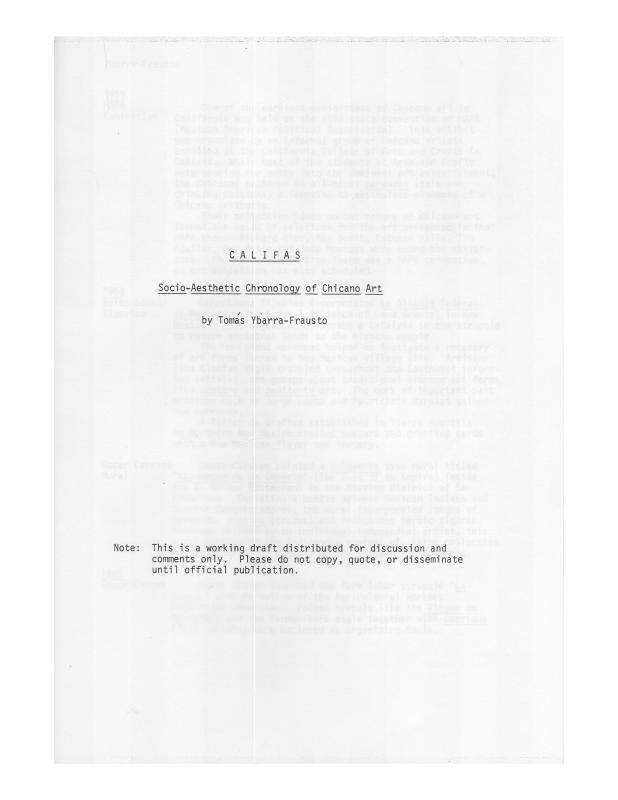
The exhibition brought together two Bay Area women artists of color, working in different print techniques, to foster dialogue between their expressive styles. Across their practice, their works are united by themes of everyday life and childhood memories and are rooted in communal customs and fictional narratives. Writing about Carmen Lomas Garza’s work, Dr. Tomás Ybarra-Frausto outlines how she brings to the fore scenes of rural Mexican American life in the Southwest, shedding light on the traditions and practices of her Tejano culture and Chicana identity through formal techniques, external influences, and stylistic tendencies. Among the formal qualities that Ybarra-Frausto highlights are Lomas Garza’s ubiquitous “monitos” (little figures) depicting scenes of daily life. Similarly, Dr. Allan M. Gordon writes about Margo Humphrey’s monotypes, focusing both on technique and content to highlight the improvisational dynamic and affective character of her works that captures the heterogeneity of Black life. Moreover, Gordon cites a diverse range of influences informing Humphrey’s practice, from music and sermons to stylistic movements such as Expressionism.
The exhibition Carmen Lomas Garza/Prints and Gouaches: Margo Humphrey/Monotypes, was organized during Castellón’s tenure as a curator at SFMOMA, following his role as the program coordinator for the Museum Intercommunity Exchange (M.I.X.). Founded by Sally Lilienthal, M.I.X. (1972–75) aimed to broaden the museum’s outreach and engagement with local communities to reflect the diversity of San Francisco, by offering community events that included concerts, performances, exhibitions, and mural commissions, hosted both at the museum as well as public venues throughout San Francisco. As part of its charge, M.I.X. sought to include artists of color within the museum’s exhibition circuit, launching its own exhibition series. Writing about M.I.X., Frankenstein names Becky Jenkins—who was originally appointed as the first program director, before Rolando Castellón was hired in May 1972. In its first year, Jenkins and Castellón served as the joint program coordinator and director of M.I.X. After 1972, Castellón directed the program until its discontinuation in 1975. Such a cessation of activities did not preclude Castellón from maintaining the ethos of M.I.X. by means of his inclusive approach to curating the work of diverse communities in the Bay Area.
Rolando Castellón (b.1937) is a Nicaraguan artist and curator who moved to San Francisco in 1956 at the age of nineteen. During his time living in the Bay Area, he was a prominent advocate for community arts programming and minority artists, working actively as a practicing artist, curator, gallerist, and cultural worker. In the late 1960s, he became involved with Casa Hispana de Bellas Artes, serving as the director of artistic programs in 1969. Coming out of this work, Castellón became a cofounder of Galería de la Raza in 1970 and was elected as the Galería’s first director before it became more established and moved away from a cooperative model. After two years, he left Galería to work at SFMOMA, first as the program coordinator and art director of M.I.X. (1972–75), and later as a full-time curator (1975–81). After his appointments at SFMOMA, he served as the director of the Mary Porter Sesnon Art Gallery at UC Santa Cruz (1982–92). During this time, he opened different iterations of Castellón Gallery, and curated exhibitions at various venues across San Francisco; among them, Drawings from the Fourth World at Meridian Gallery in 1989. In 1993, he moved back to Costa Rica, where he had briefly lived as a young boy, and was appointed the chief curator of the Museum of Contemporary Art and Design (MADC) in 1994. He continues to live and work in San José, Costa Rica.
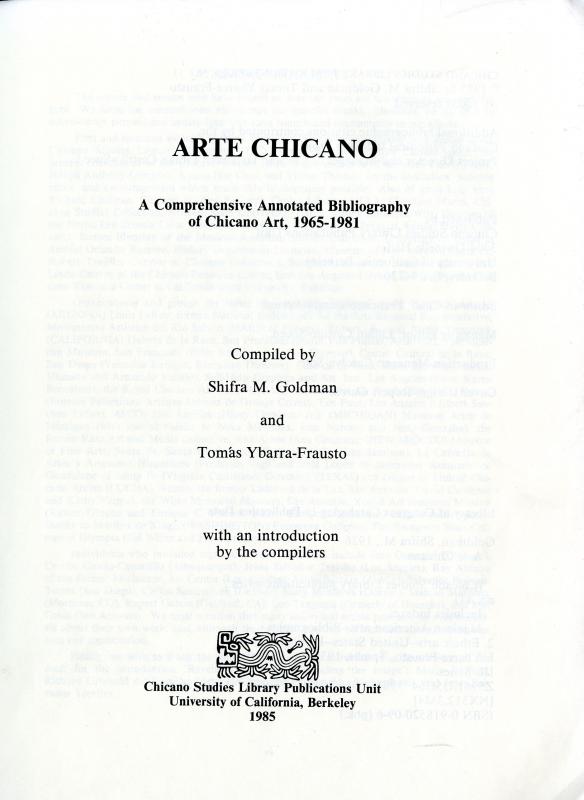
Tomás Ybarra-Frausto (b. 1938), a native of San Antonio, is an independent scholar of US Chicano and Latin American arts and culture. He was previously an associate director of arts and culture at the Rockefeller Foundation and a tenured professor at Stanford University. At the time of writing this essay, he was a professor at Stanford in the Department of Spanish and Portuguese. His work and scholarship is foundational for researchers of Chicano art and was essential to documenting Chicano art and providing critical frameworks for its study (See, in the ICAA Digital Archive, [docs. no. 1082145 and no. 849294].) He participated, with Mari Carmen Ramírez and Héctor Olea, as editors and authors of the first volume the ICAA’s anthology series Critical Documents of 20th Century Latin American and Latino Art: Resisting Categories: Latin American and/or Latino? (Houston and London: The Museum of Fine Arts, Houston / Yale University Press, 2012).