José Antonio Burciaga (1940–1996) was a Chicano activist, muralist, writer, and poet from El Paso, Texas. He earned a BFA from University of Texas at El Paso (1968) and worked as an illustrator and graphic artist in Texas. He moved to California in 1974, where he wrote articles for newspapers and journals, as well as several books of poems and essays. He painted (and then vandalized) a mural in Redwood City in 1977. (See in the ICAA Digital Archive, “Art Vandalized in Protest,” [doc. no. 1480012]). Burciaga was a founding member of Culture Clash, a Latino comedy troupe at the Galería de la Raza in San Francisco and performed with the group from 1984 to 1988. In 1985, he was appointed as a Resident Fellow in Casa Zapata. As part of his work, Burciaga installed several murals, including The Last Supper of Chicano Heroes (1989), in the dormitory’s dining hall. Burciaga served in this role for ten years alongside his wife, Cecilia Burciaga (1945–2013), an activist, educator, administrator, and dean at Stanford.
This letter mentions Burciaga’s time at Stanford (1985–94) and describes his feeling of total alienation within the university. He also laments not having the chance to connect with Tomás Ybarra-Frausto, who was teaching in the Spanish and Portuguese Department of the university during the same time. Casa Zapata is mentioned by name, as is “El Centro,” that is, El Centro Chicano, a Chicano student center started by his wife, Cecilia. In this letter, Burciaga discusses the boycott of the CARA show, citing broad concern about the exclusionary and rigid definitions concerning Chicano art.
Chicano Art: Resistance and Affirmation (CARA) was the first Chicano art exhibit of its size—organized by Chicana/o scholars and curators with a national advisory committee—to travel nationally. Planning for the exhibition began in 1984 and the show opened at the Wight Art Gallery at UCLA in September 1990. The exhibition traveled to nine more museums across the United States between 1990 and 1993: San Francisco Museum of Modern Art (SFMOMA); Fresno Art Museum; Tucson Museum of Art; Denver Art Museum; Albuquerque Museum of Art and History; National Museum of American Art, Washington, DC; The Bronx Museum of the Arts; El Paso Museum of Art; and the San Antonio Museum of Art. Each local exhibition had corresponding programming that emphasized local Chicana/o artists and culture, including lowrider cars shows in El Paso and Albuquerque.
The original exhibition at UCLA included 128 works and documentation of fifty-four murals by 180 Chicano/a artists. It was divided in ten sections: a historical timeline and nine thematic segments: La Causa, Cultural Icons, Civil Liberties, Urban Images, Murals, Regional Expressions, Reclaiming the Past, Feminist Visions, and Redefining American Art. In addition, three groups were featured with one-room installations: the collectives Asco, Los Four, and the Royal Chicano Air Force. The CARA exhibition catalogue served as a vital site of scholarship regarding Chicano/a art. The exhibition continues to be foundational for current Chicano/a art scholarship.
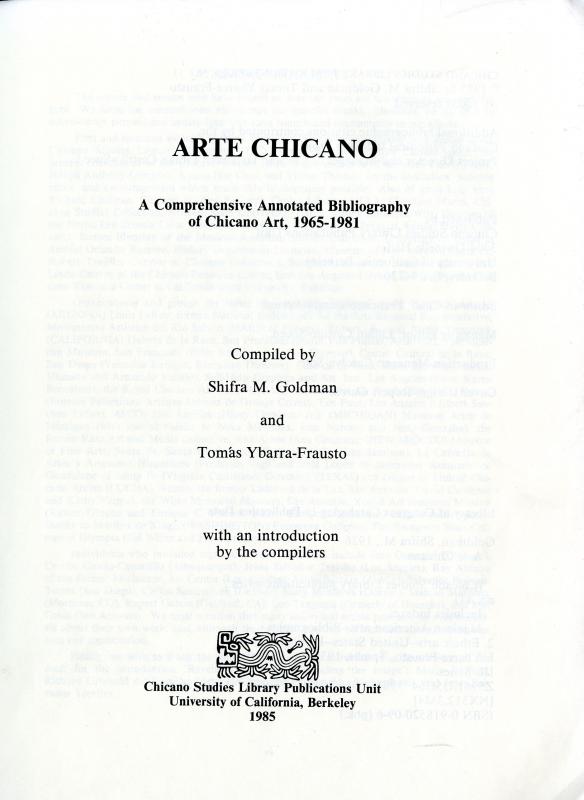
Shifra M. Goldman (1926–2011) became a major figure in the fields of Latin American and Latino art history. Trained as n historian, she was also known as an art critic, curator, educator, and activist whose pioneering work helped shape these areas of art history, particularly Mexican and Chicano art history. Goldman was born and raised in New York City. She earned a BA in art from the University of California, Los Angeles (UCLA), in 1963, and an MA in art history from Cal State Los Angeles in 1966. Her PhD in art history is from 1977; it must be underscored that she had to wait several years for a faculty member to advise and approve her dissertation topic on modern Mexican Art. At that time, the area was academically underappreciated. Goldman has published extensively (and presciently) on Mexican, Latin American, and Latino/Chicano art. She taught at several institutions, including Santa Ana College until 1992. Goldman has published widely, including the 1985 Arte Chicano: A Comprehensive Annotated Bibliography of Chicano Art, 1965–1981, a bibliography and theoretical essay coauthored with scholar Tomás Ybarra-Frausto, (See ICAA Digital Archive [doc. no. 849294]). She was an original planner and committee member for the landmark exhibition CARA: Chicano Art: Resistance and Affirmation (1990–93).