Ever since it was founded, the CAYC (Centro de Arte y Comunicación), helmed by the cultural promoter, artist, and businessman Jorge Glusberg, was intended as an interdisciplinary space where an experimental art movement could flourish. The establishment of collaborative networks connecting local and international artists and critics played an important role in this process. In addition to the exhibitions, a program of different activities exposed attendees to the latest in scientific thinking. According to Glusberg, the coordination between theoretical thinking and artistic practice was an essential part of social change.
During the military dictatorship of General Juan Carlos Onganía, the CAYC became a cultural home for the Fundación de Investigación Interdisciplinaria (Foundation for Interdisciplinary Research), a space that welcomed a group of dissident professors from the Facultad de Arquitectura y Ciencias Exactas de la Universidad de Buenos Aires after the military takeover of the university in what came to be known as “La Noche de los Bastones Largos” (The Night of the Long Sticks) in June 1966. In its early years the center organized a variety of activities with intellectuals that contributed to the circulation of ideas from different disciplines (analytic philosophy, mathematical logic, epistemological problems, psychology, semiotics, and linguistics), which had been excluded from official circles.
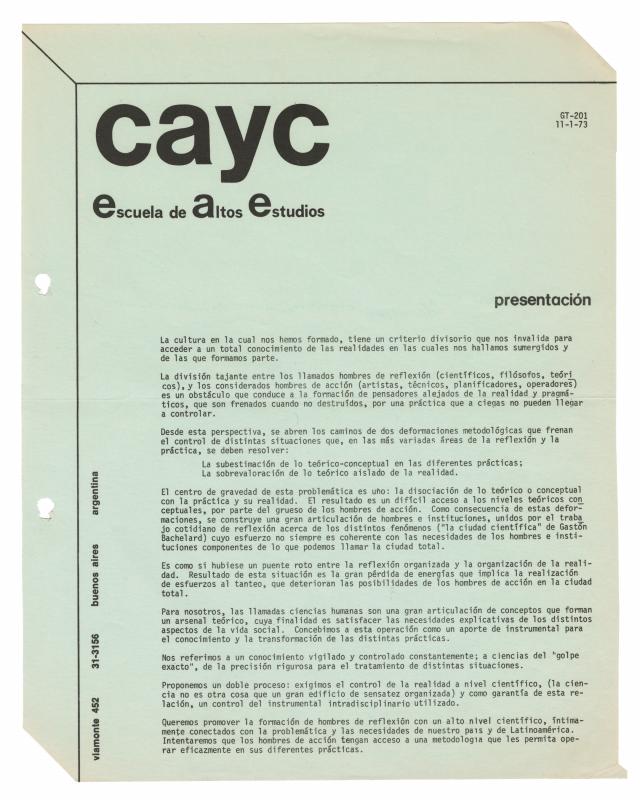
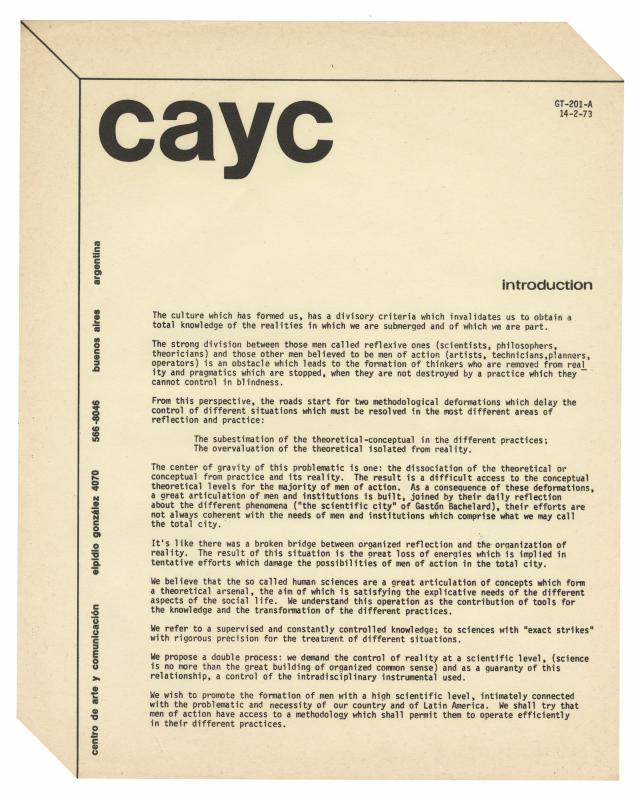
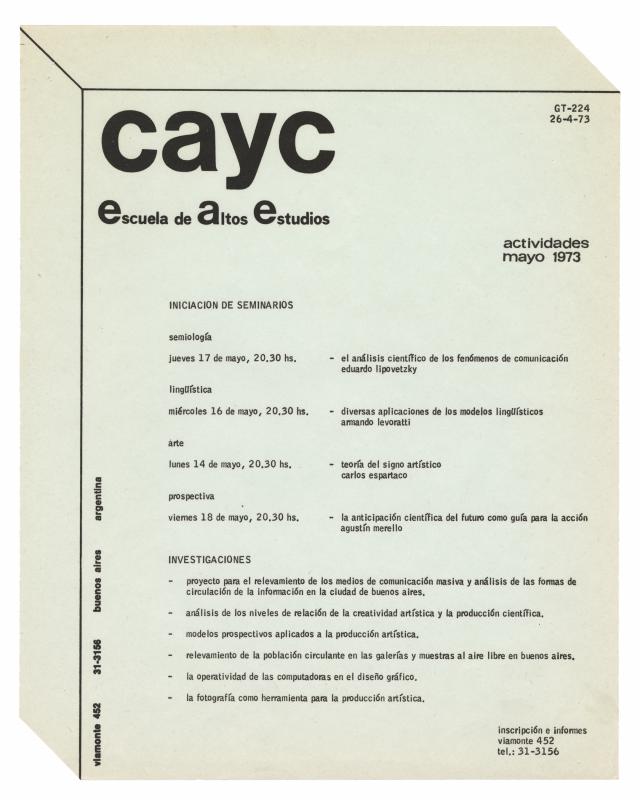
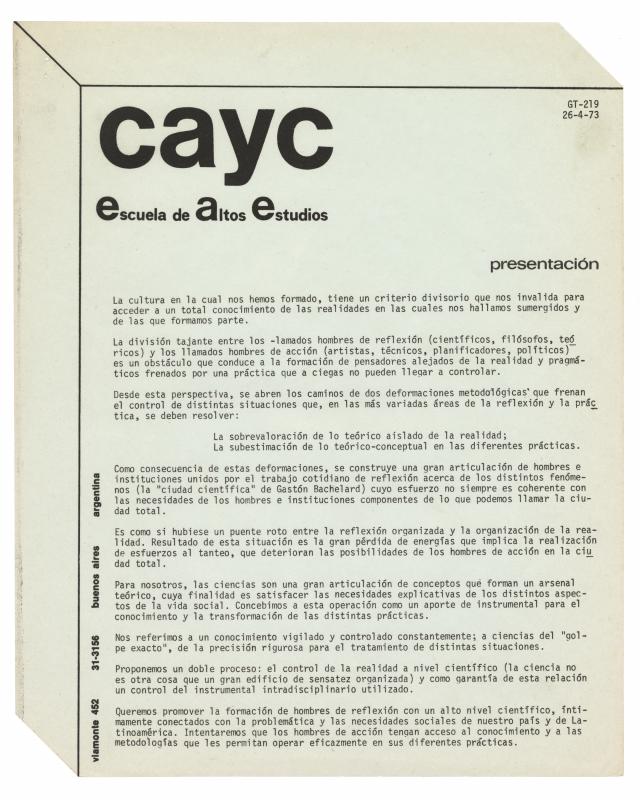
The center’s interest in this sort of cyclical event led to the creation of the Escuela de Altos Estudios (EAE, the School of Advanced Studies) in early 1973. The objectives described in the newsletters that announced the school’s creation (GT-201; doc. no. 1478752, GT-201- A; doc. no. 1478753, GT-224; doc. no. 1478771, GT-219; doc. no. 1478755) were apparent in the activities organized by the EAE, as well as in the work produced by artists associated with the center.
This newsletter invites readers to “Treinta años en el arte norteamericano” (Thirty Years in North American Art), a course to be taught by Fermín Fèvre at the CAYC. The course will cover the period from 1935 to 1965, when North American art gained visibility on the international stage and managed to transfer the center of the art world and its operations, gatherings, and finances from Europe to the United States. Fèvre will review contextual factors and the ideas explored by different movements, including Abstract Expressionism, Action painting, geometric abstraction, and Pop art—the latest trend at the time.
This course was of great interest because, until that time, North American art was not included in any of the art history classes being taught in Argentina. The CAYC saw this sort of event as a way to expose the possibilities offered by new movements, especially those that supported the center’s program of activities.