Ever since it was founded, the CAYC (Centro de Arte y Comunicación), helmed by the cultural promoter, artist, and businessman Jorge Glusberg, was intended as an interdisciplinary space where an experimental art movement could flourish. The establishment of collaborative networks connecting local and international artists and critics played an important role in this process. In addition to the exhibitions, a program of different activities exposed attendees to the latest in art and scientific thinking. According to Glusberg, the coordination between theoretical thinking and artistic practice was an essential part of social change.
During the military dictatorship of General Juan Carlos Onganía, the CAYC became a cultural home for the Fundación de Investigación Interdisciplinaria (Foundation for Interdisciplinary Research), a space that welcomed a group of dissident professors from the Facultad de Arquitectura y Ciencias Exactas de la Universidad de Buenos Aires after the military takeover of the university in what came to be known as “La Noche de los Bastones Largos” in June 1966. In its early years the center organized a variety of activities with intellectuals that contributed to the circulation of ideas from different disciplines (analytical philosophy, mathematical logic, epistemological problems, psychology, semiotics, and linguistics), which had been excluded from official circles.
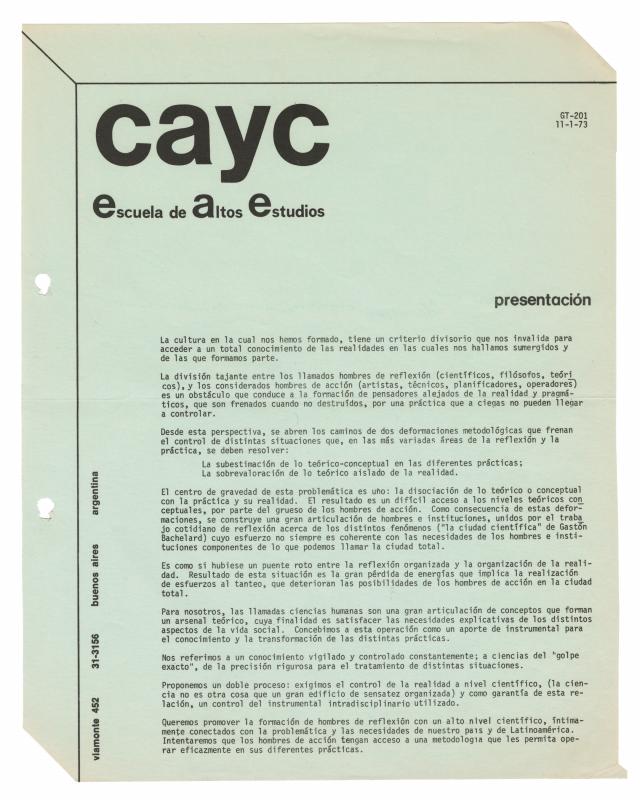
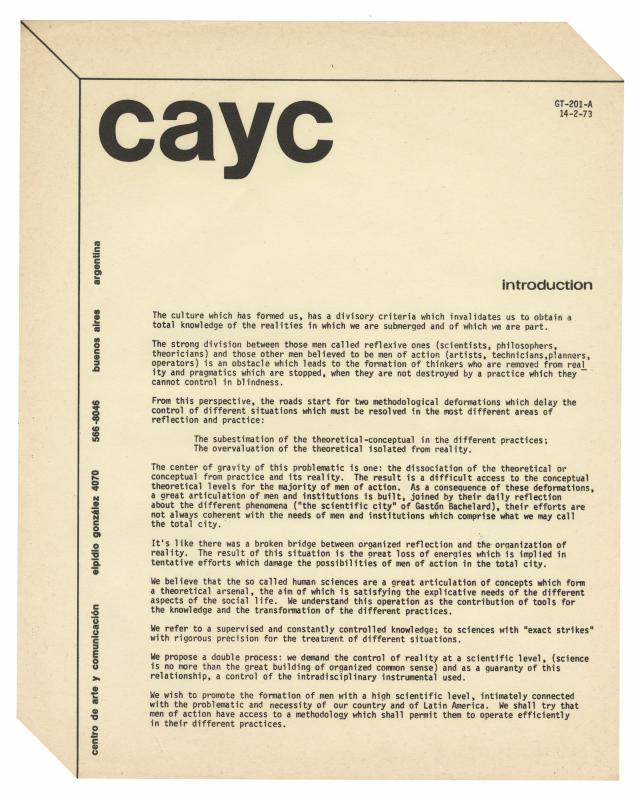
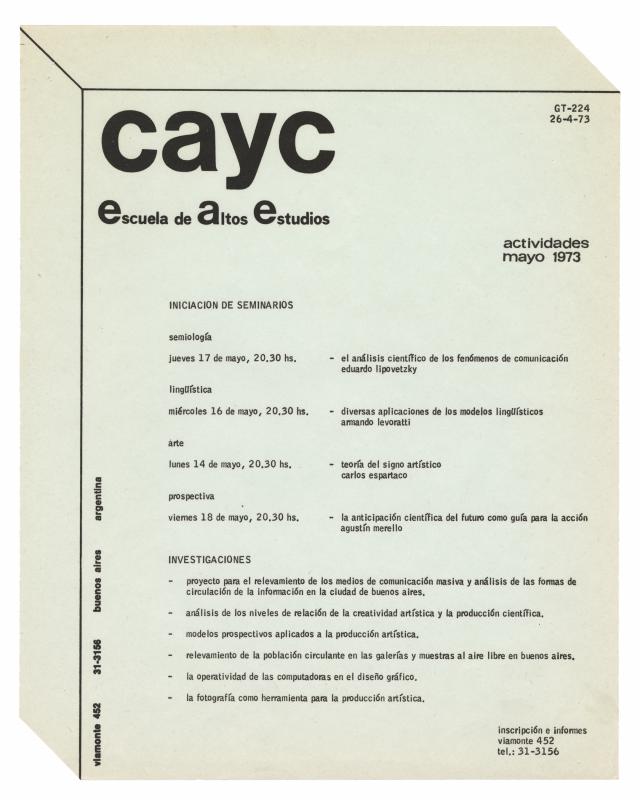
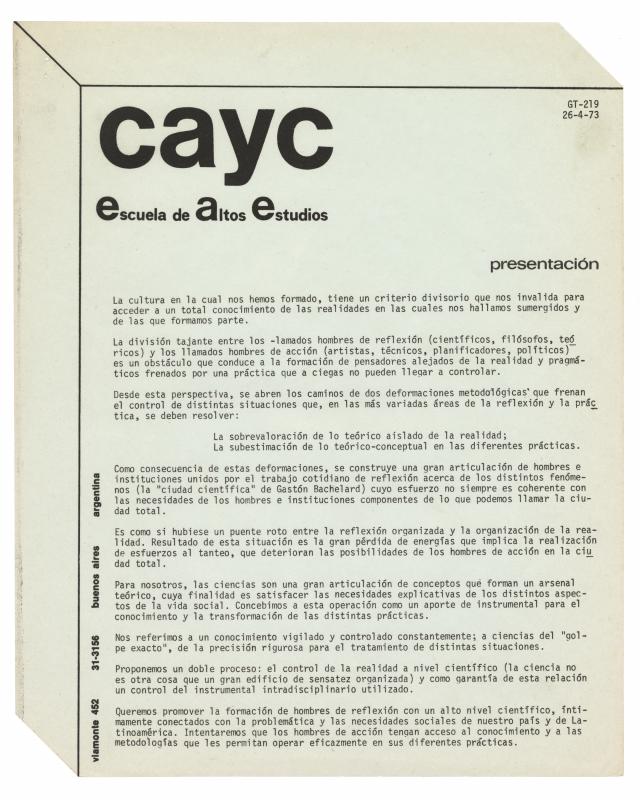
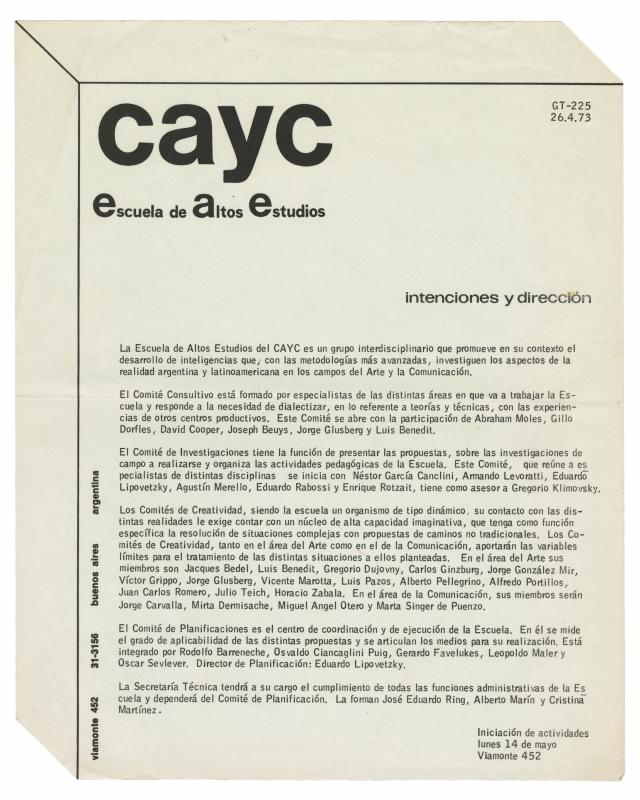
According to Glusberg, the coordination between theoretical thinking and artistic practice was an essential part of social change. The center’s interest led to the creation of the Escuela de Altos Estudios (EAE, the School of Advanced Studies) at the CAYC in early 1973. (GT-201; doc. no. 1478752, GT-201- A; doc. no. 1478753, GT-224; doc. no. 1478771, GT-219; doc. no. 1478755; GT-225; doc. no. 1478772).
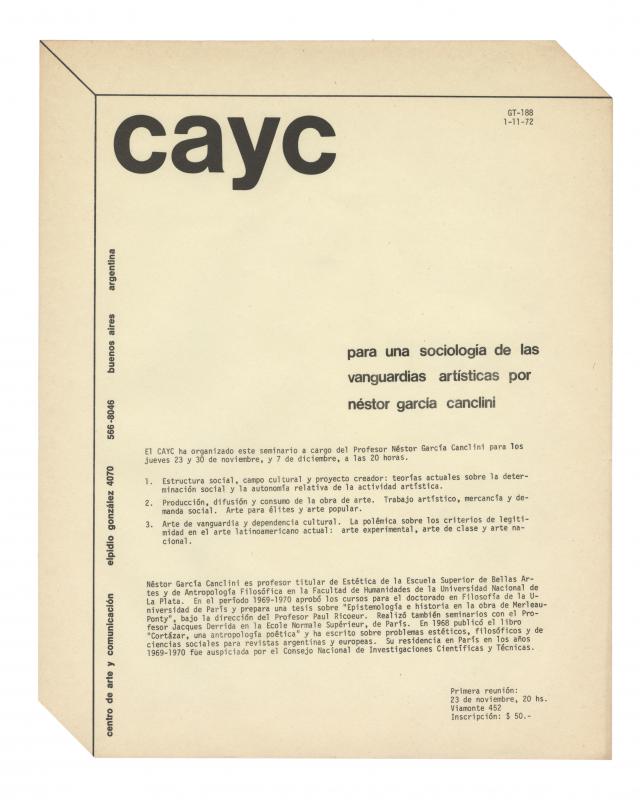
Having delivered his first seminar at the CAYC toward the end of the previous year (GT- 188; doc. no. 1478743), Néstor García Canclini (b. 1939), the writer, anthropologist, and cultural promoter, presented the one announced in this newsletter: “Nuevas formas de comunicación entre artistas y público en América Latina 1960–1975” (New forms of communication between artists and audiences in Latin America 1960–1975). In this lecture he analyzed the relationships between society and art, providing a critical review of the historical circumstances surrounding the art in question. This approach allowed him to consider the role of Latin American artists within the relevant sociopolitical context. These same thoughts were expressed under the same title in a text published by the Centro Editor de América Latina some months earlier. In that text he proposed the necessary “[…] interaction between the possibilities of an artistic language and the demands for liberation of a class and a society.” Canclini referred to several works created by artists involved with the center as examples of the possible organization of a “popular art” that was related to current forms of artistic expression. This was a pioneering work concerning the sociology of Latin American culture, which introduced the French sociologist Pierre Bourdieu’s “field theory.” In time, it became required reading for understanding the aesthetic expressions of that period as well as local cultural problems.
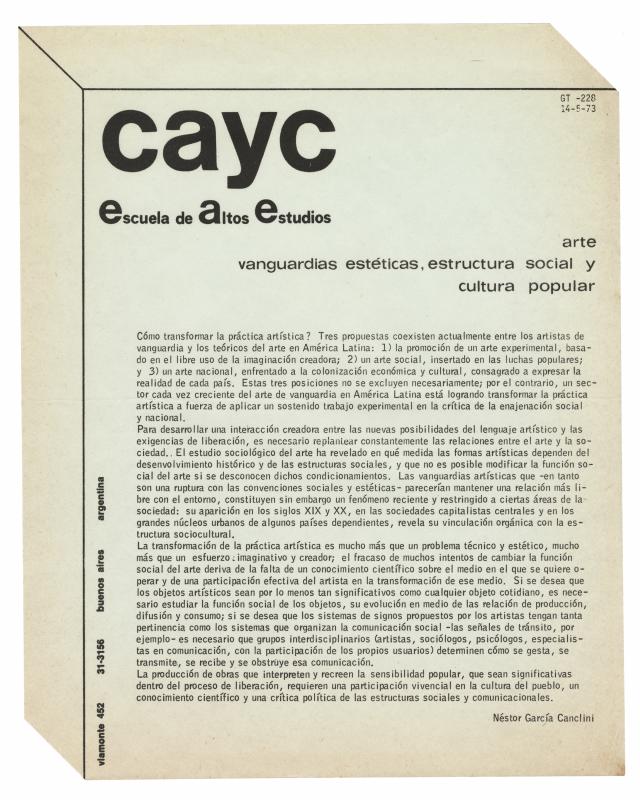
During the 1970s, García Canclini thought that avant-garde practices should be introduced in the area of social struggles, inviting politicized artists to abandon art and transform “their works into rehearsals or triggers for a political event” (García Canclini, N. (1972). “El artista en la ciudad. Para un replanteo político de la función de las vanguardias artísticas” [The artist in the city. For a new political approach to the role of the artistic avant-garde]. In Revista de la Universidad, n° 24, pp. 349-371). He thus suggested addressing the challenge of how to produce art that would be part of ordinary people’s daily lives and be actively involved in the process of liberation (GT- 228; doc. no. 1478773).