Ever since it was founded, the CAYC (Centro de Arte y Comunicación), helmed by the cultural promoter, artist, and businessman Jorge Glusberg, was intended as an interdisciplinary space where an experimental art movement could flourish. The establishment of collaborative networks connecting local and international artists and critics played an important role in this process. The exhibitions shone a light on these exchanges, in which overviews of trends or individual artists provided an introduction to the innovations of international contemporary art and made Argentine and Latin American artists better known on the global scene.
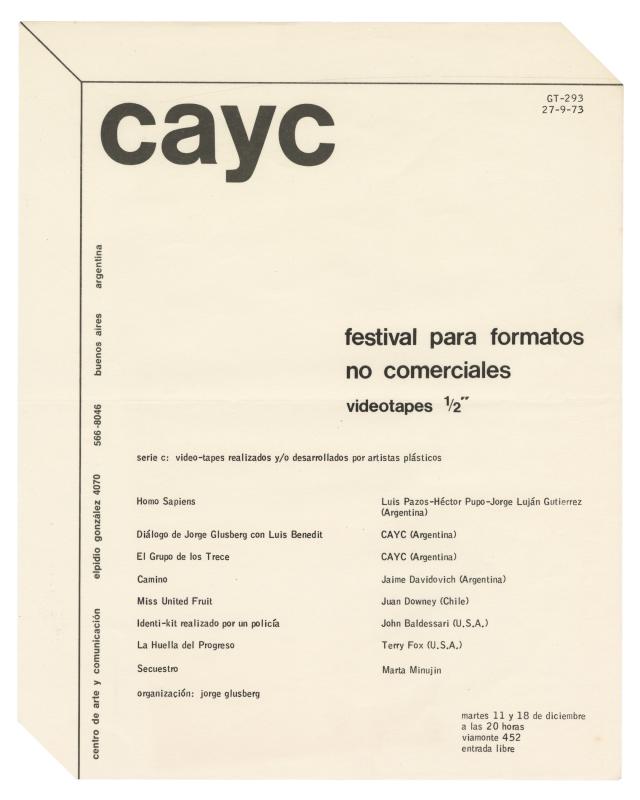
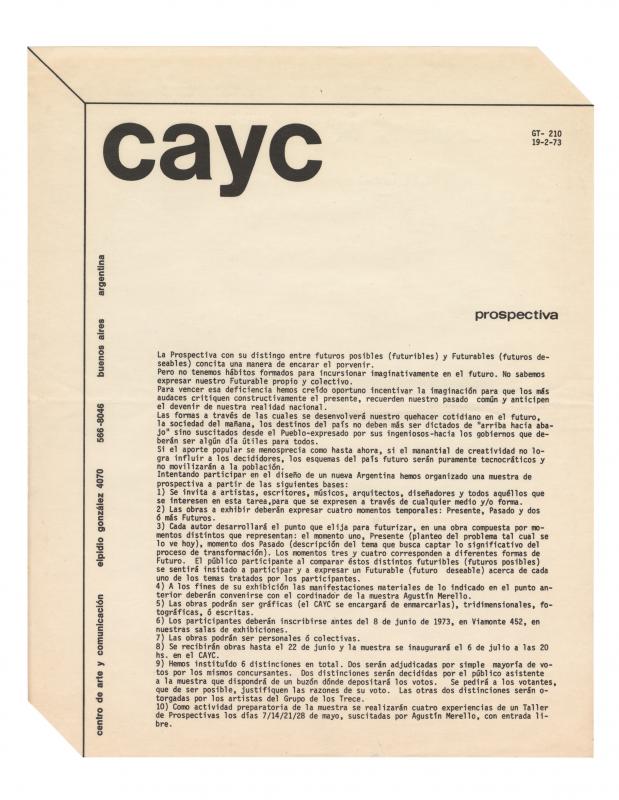
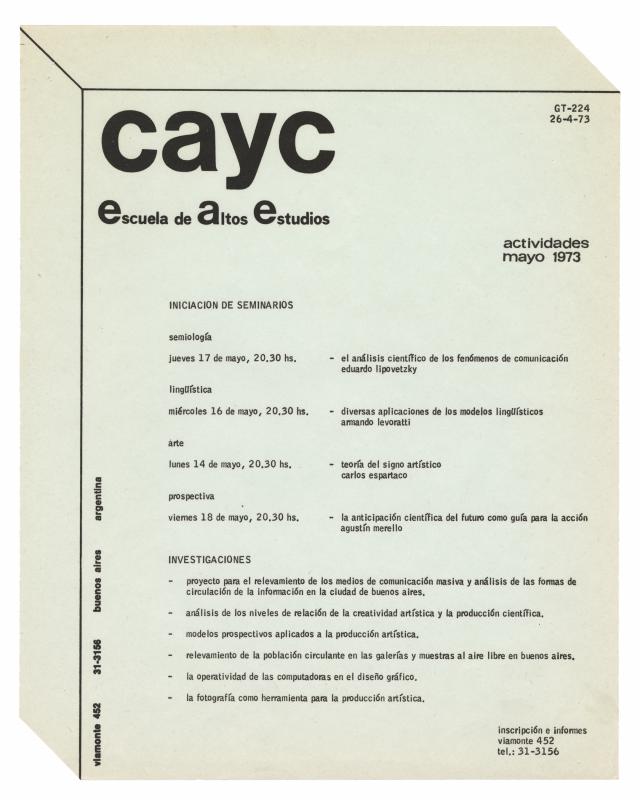
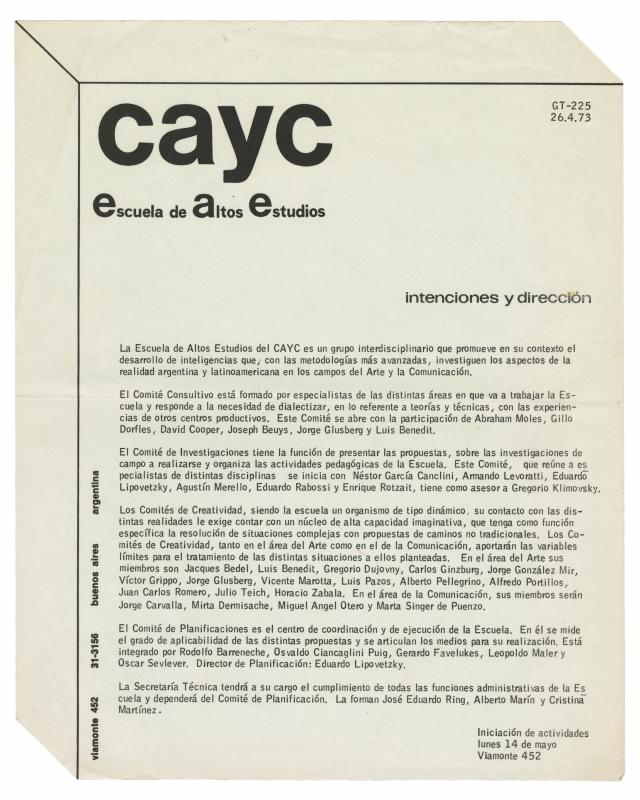
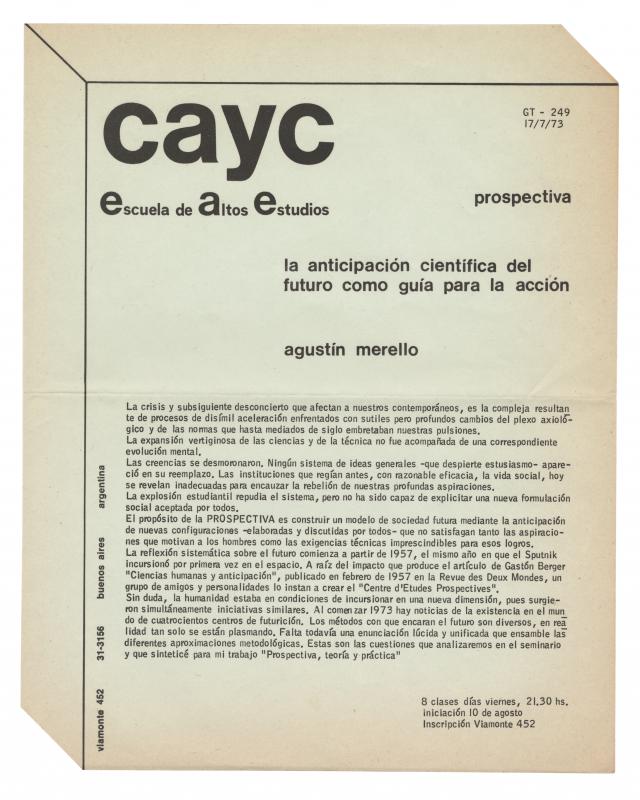
Marta Minujín (b. 1943) has been one of the central figures in the Argentinean avant-garde scene since the 1960s. Ever since that defining decade, she has had a prolific career that includes happenings, performance, sculpture, painting, and video art. After spending several years living in Europe and New York, Minujín returned to Buenos Aires where she settled in 1975 and, from then on, was a regular participant in the CAYC’s activities. She became involved in the center’s events in 1970 (GT-7; doc. no. pendiente, GT-44; doc. no. pendiente, GT-293; doc. no. 1476441, GT-485; doc. no. 1476726), as did Agustín Merello, a professor of philosophy (GT-210; doc. no. 1478194, GT-224; doc. no. 1478771, GT-225; doc. no. 1478772, GT-249; doc. no. 1478795) who participated in seminars in which he promoted the model of la prospectiva, which he described as “a scientific preview of the future as a guide to action.”
When Minujín returned to Argentina she found the country in political turmoil. The death of Juan Domingo Perón (1974) created a climate of institutional uncertainty. His widow, María Estela Martínez de Perón, became the president and her term in office was marked by escalating waves of violence, as expressed in the struggle between competing factions in the political spectrum and the activities of armed paramilitary groups such as the Triple A (Alianza Anticomunista Argentina).
In these complex circumstances a group of artists and intellectuals—including Minujín, Merello (mentioned above), Pier Cantamessa, Carlos Bronovsky, Mercedes Esteves, Charlie Espartaco, Florencio (Chito) Méndez Casariego, and Federico Peralta Ramos—sought to demythologize the triumphalist imperatives that blithely predicted failure. Minujín expressed some of the ideas that came out of those gatherings in La academia del fracaso, the event that opened at the CAYC on September 26, 1975, jointly produced with Merello. The exhibition consisted of a series of actions based on the concept of “failure” to be experienced at the CAYC premises, followed by a course of lectures. At the end of the program, participants were awarded the “Certificado Internacional de Vacunación contra el Triunfalismo,” thus challenging any spark of optimism under authoritarian governments.
This newsletter presents the “Certificate” in the satirical terms that define Minujín’s work. Participants in La academia del fracaso symbolically graduated as “transfailures” who were thus granted immunity from the demands of a “success-driven” world.