Ever since it was founded, the CAYC (Centro de Arte y Comunicación), helmed by the cultural promoter, artist, and businessman Jorge Glusberg, was intended as an interdisciplinary space where an experimental art movement could flourish. The establishment of collaborative networks connecting local and international artists and critics played an important role in this process. In addition to the exhibitions, a program of different activities exposed attendees to the latest in scientific thinking. According to Glusberg, the coordination between theoretical thinking and artistic practice was an essential part of social change.
Architecture and design were always basic components of the CAYC’s interdisciplinary approach. In its early years, the center became affiliated with the Fundación de Investigación Interdisciplinaria , an organization that welcomed a group of dissident professors from the Facultad de Arquitectura y Ciencias Exactas at the Universidad de Buenos Aires following the forced occupation of universities that took place after the coup d’état in 1966. That earlier affiliation left an indelible mark on various aspects of the CAYC’s operations, such as its approach to many of its initiatives as “projects;” the use of heliographic copies (a technique usually used for copying blueprints) in its exhibitions; the center’s partnering with the industrial sector in exhibitions and contests; and the presence of several artist-architects among the founders of the Grupo de los Trece.
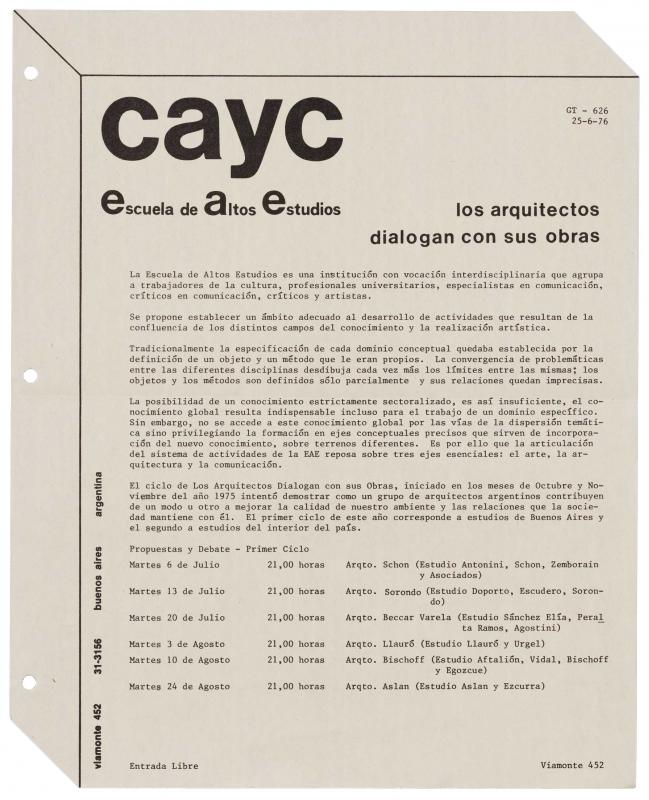
This newsletter announces “Los arquitectos dialogan con sus obras”, a new program of talks to be held at the CAYC in June 1977. This program had been presented before, in October through November 1975 (GT- 560; doc. no. pending) and in July through August 1976 (GT-626; doc. no. 1478949). The program was attended by the top modern architecture firms in Argentina, first in Buenos Aires, then in the city of Córdoba, and then in La Plata.
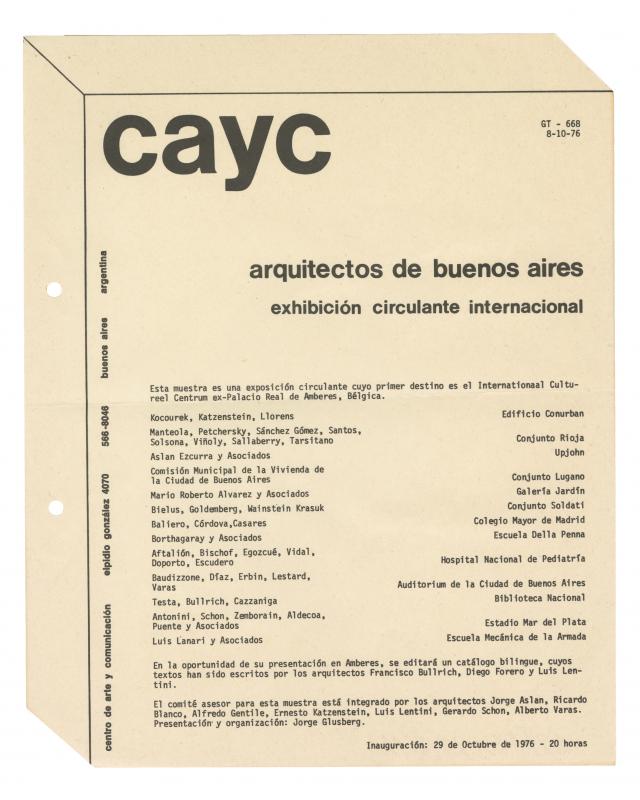
Some of these firms showed their projects at the exhibition Arquitectos de Buenos Aires , which was presented at European institutions in that same year (GT- 668; doc. no. 1477400). The newsletter provides details on the scheduling of the program, and underscores how important the first graduates in Architecture and Urban Planning from the Universidad Nacional are to the promotion of modern architecture.
As part of this event, the center offered spaces for reflection and visibility for the discipline, providing information about the theories and methodologies used for creative activities that support the CAYC’s activities.