Ever since it was founded, the CAYC (Centro de Arte y Comunicación), helmed by the cultural promoter, artist, and businessman Jorge Glusberg, was intended as an interdisciplinary space where an experimental art movement could flourish. The establishment of collaborative networks connecting local and international artists and critics played an important role in this process. In addition to the exhibitions, a program of different activities exposed attendees to the latest in art and scientific thinking. According to Glusberg, the coordination between theoretical thinking and artistic practice was an essential part of social change.
Architecture was a basic component of the CAYC’s interdisciplinary approach. In its early years, the center became affiliated with the Fundación de Investigación Interdisciplinaria (Foundation for Interdisciplinary Research), an organization that welcomed a group of dissident professors from the Facultad de Arquitectura y Ciencias Exactas at the Universidad de Buenos Aires following the forced occupation of universities that took place after the coup d’état in 1966. That earlier affiliation left an indelible mark on various aspects of the CAYC’s operations, such as its approach to many of its initiatives as “projects;” the use of heliographic copies (a technique usually used for copying blueprints) in its exhibitions; the center’s partnership with the industrial sector in exhibitions and contests; and the presence of several artist-architects among the founders of the Grupo de los Trece.
The participatory spirit that was a key aspect of the center’s initiatives is clearly apparent in this message that invites readers (regardless of their knowledge or architecture) to share their opinions on the architectural development of Buenos Aires over the next five years. Readers are also offered the chance to be part of a study group that will explore the subject. This was a frequent approach taken at the gatherings of different disciplines organized by the Escuela de Altos Estudios (EAE, the School of Advanced Studies) that was part of the CAYC.
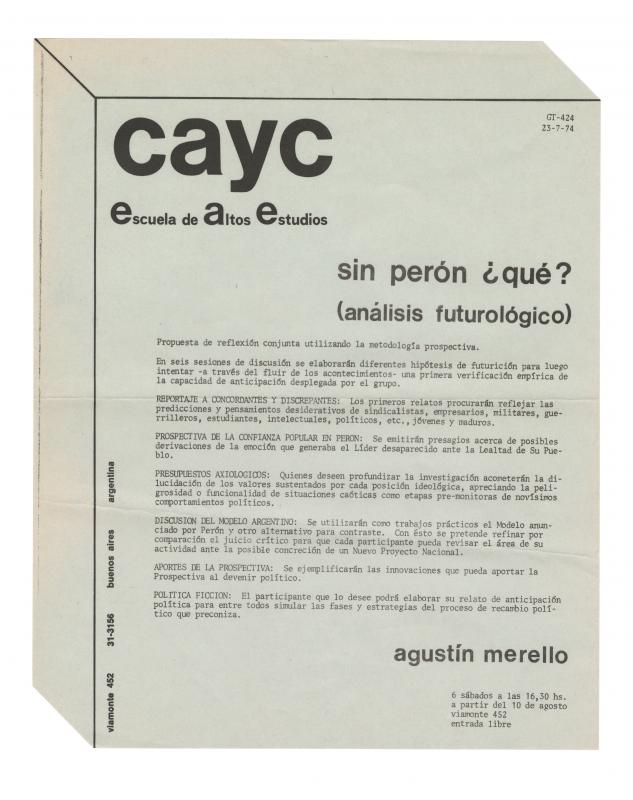
The urgent need to think about the present and the immediate future from the perspective of different disciplines was an integral aspect of the center’s projects at that time. This can be attributed to the growing political and institutional uncertainty following the death of Juan Domingo Perón on July 1 the previous year during his third term as president (GT-424; doc. no. 1478898).