Ever since it was founded, the CAYC (Centro de Arte y Comunicación), helmed by the cultural promoter, artist, and businessman Jorge Glusberg, was intended as an interdisciplinary space where an experimental art movement could flourish. The establishment of collaborative networks connecting local and international artists and critics played an important role in this process. In addition to the exhibitions, a program of different activities exposed attendees to the latest in scientific thinking. According to Glusberg, the coordination between theoretical thinking and artistic practice was an essential part of social change.
Architecture and design were always basic components of the CAYC’s interdisciplinary approach. In its early years, the Center became affiliated with the Fundación de Investigación Interdisciplinaria [Foundation for Interdisciplinary Research], an organization that welcomed a group of dissident professors from the Facultad de Arquitectura y Ciencias Exactas at the Universidad de Buenos Aires following the forced occupation of universities that took place after the coup d’état in 1966. That earlier affiliation left an indelible mark on various aspects of the CAYC’s operations, such as its approach to many of its initiatives as “projects;” the use of heliographic copies (a technique usually used for copying blueprints) in its exhibitions; the Center’s partnering with the industrial sector in exhibitions and contests; and the presence of several artist-architects among the founders of the Grupo de los Trece.
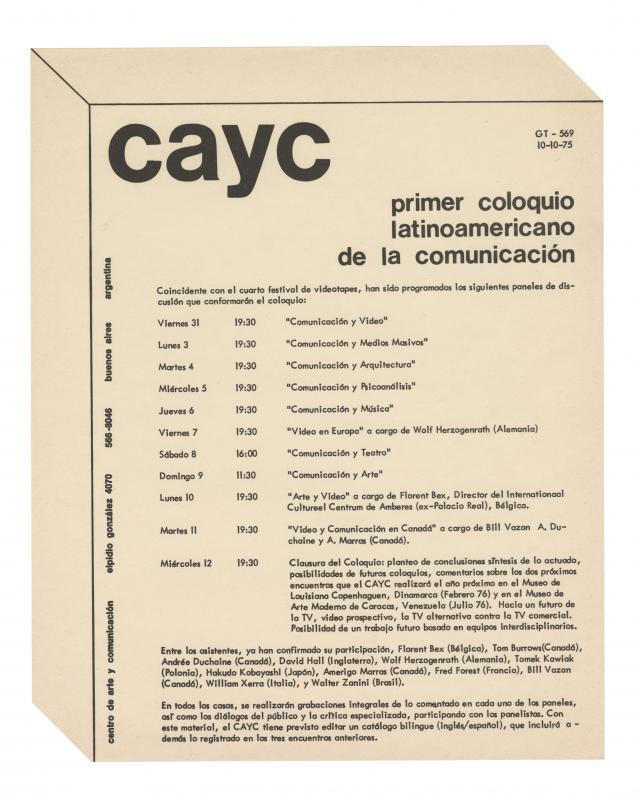
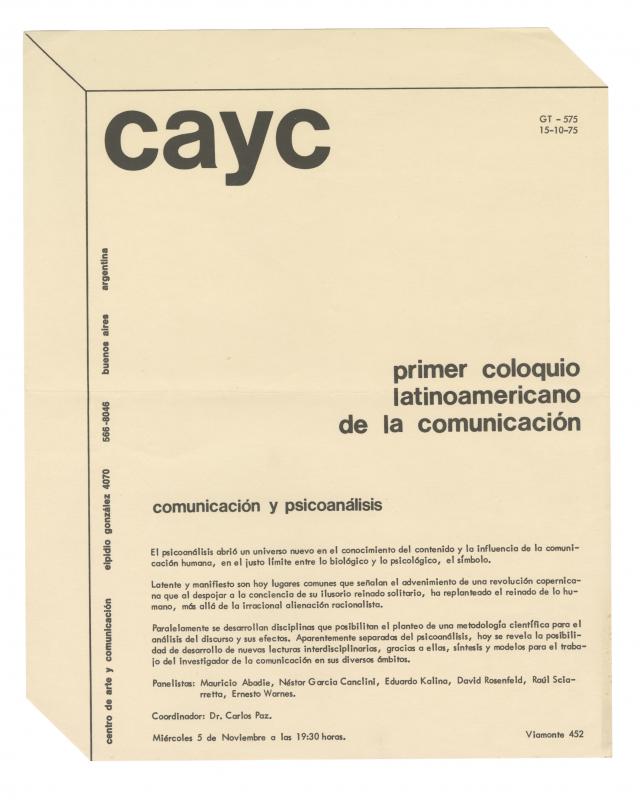
This newsletter announces a roundtable discussion, “Comunicación y arquitectura” [Communication and Architecture], as part of the “Coloquio Latinoamericano de la Comunicación” [Latin American Symposium on Communication] (GT-569; doc. no. 1478992, GT-572; doc. no. 1478994, GT-575; doc. no. 1478996). Participants included noted architects and designers, such as Alfredo Gentile, Mario Goldman, Luis Lentini, Lala Méndez Mosquera, Juan Molina and Vedia Ruben Pesci, Alberto Varas, Rafael Viñoly, and Marcos Winograd; the event was coordinated by César Jannello.
César V. Jannello (1918-85), an architect, designer, teacher, and design theorist, was a key figure in the field of Argentine architecture who gained international recognition with his design of Silla W [Chair W] (1947). In the late 1940s he was part of the drive to consolidate the Movimiento Concreto, the concrete movement that was associated with the visual arts and broadened the scope of his creative influence by founding the OAM (Organización para la Arquitectura Moderna) [Modern Architecture Organization]. Janello introduced semiology to Argentina where it became an integral part of architectural teaching.
The Center used this event to demonstrate what the new social theories might do for artistic activity, especially those that supported the CAYC’s program of events and the creation of an institutional poetics of its own that would give it a regional identity.