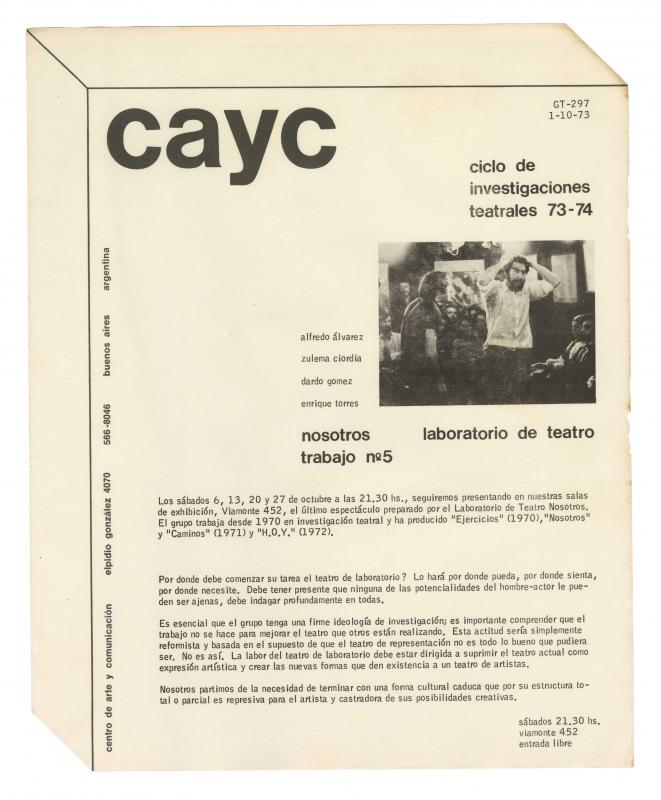
Ever since it was founded, the CAYC (Centro de Arte y Comunicación), helmed by the cultural promoter, artist, and businessman Jorge Glusberg, was intended as an interdisciplinary space where an experimental art movement could flourish. The establishment of collaborative networks connecting local and international artists and critics played an important role in this process. In addition to the exhibitions, a program of different activities exposed attendees to the latest in art and scientific thinking. According to Glusberg, the coordination between theoretical thinking and artistic practice was an essential part of social change.
Architecture and design were always basic components of the CAYC’s interdisciplinary approach. In its early years, the Center became affiliated with the Fundación de Investigación Interdisciplinaria [Foundation for Interdisciplinary Research], an organization that welcomed a group of dissident professors from the Facultad de Arquitectura y Ciencias Exactas at the Universidad de Buenos Aires following the forced occupation of universities that took place after the coup d’état in 1966. That earlier affiliation left an indelible mark on various aspects of the CAYC’s operations, such as its approach to many of its initiatives as “projects;” the use of heliographic copies (a technique usually used for copying blueprints) in its exhibitions; the Center’s partnering with the industrial sector in exhibitions and contests; and the presence of several artist-architects among the founders of the Grupo de los Trece.
This newsletter invites readers to a seminar, “Diseño de dos objetos” [Design of Two Objects], (a trailer and a lighting fixture), to be jointly presented by Arturo F. Montagu (who died in 2005), Dr. Roberto Mitelpunk, and Glusberg at the CAYC in November 1975. Montagu was one of the architects who pioneered the use of computers in design at the UBA’s Facultad de Diseño y Urbanismo. He had studied furniture design with the Finnish architect and designer Alvar Aalto. He wrote two important books on that subject: Cultura digital. Comunicación y sociedad [Digital Culture. Communication and Society], and Datarq 2000. Base de datos de la arquitectura moderna [Datarq 2000. A Database for Modern Architecture].
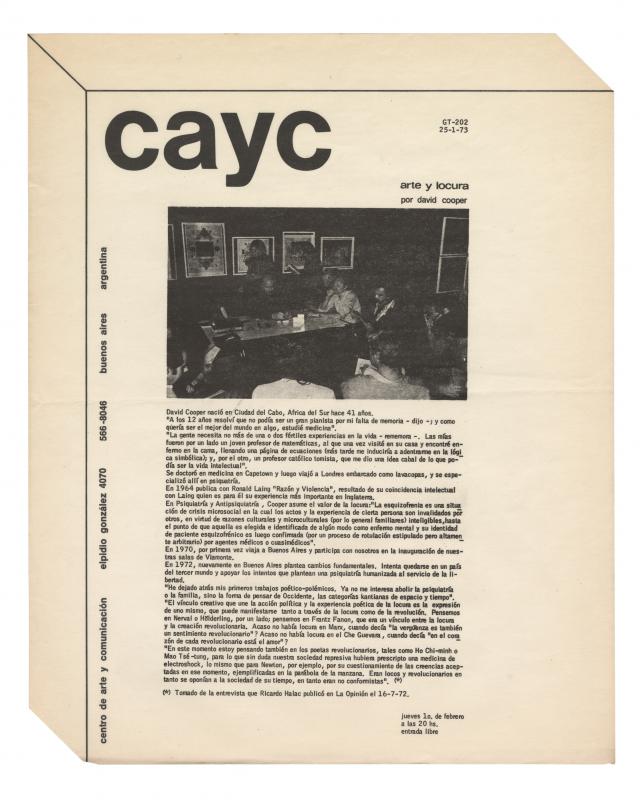
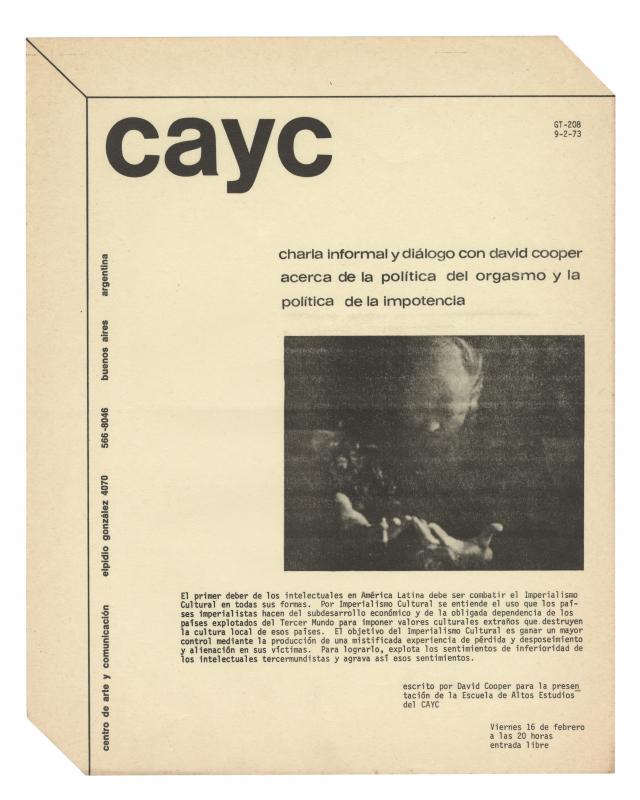
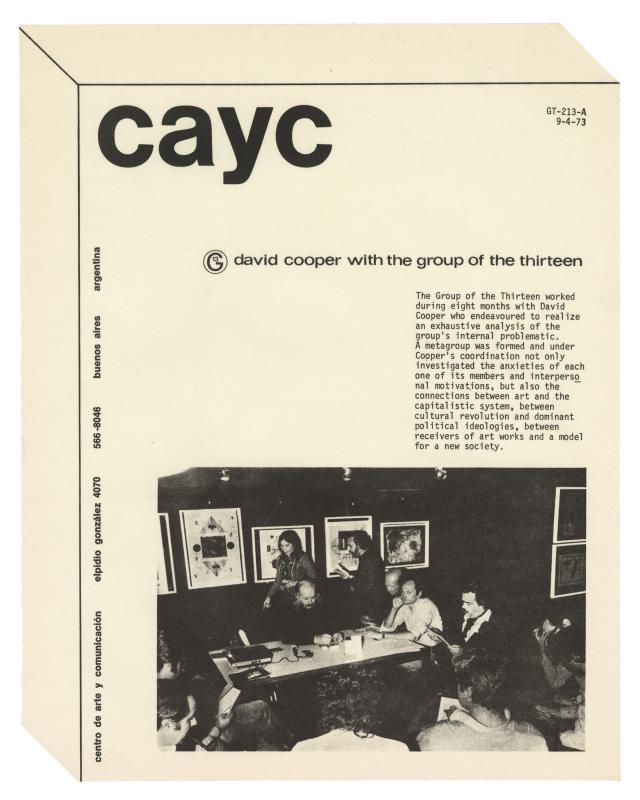
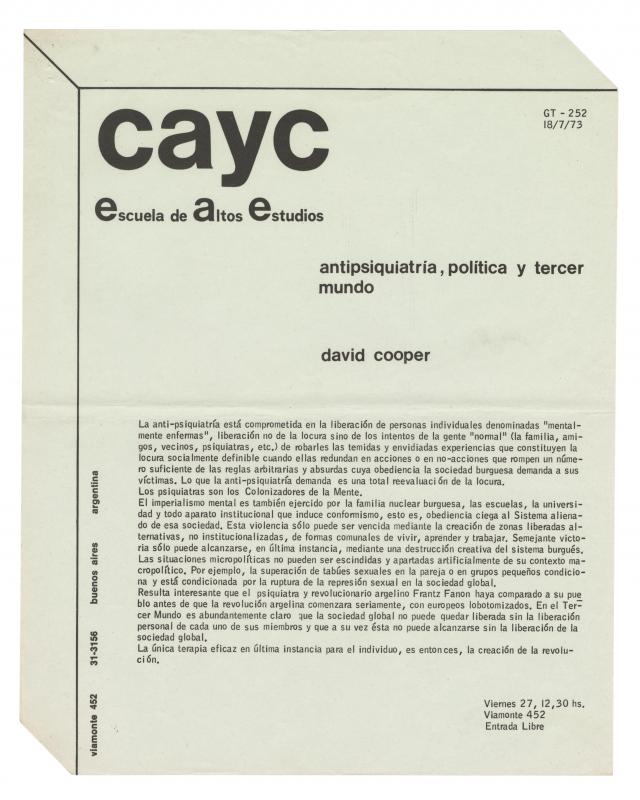
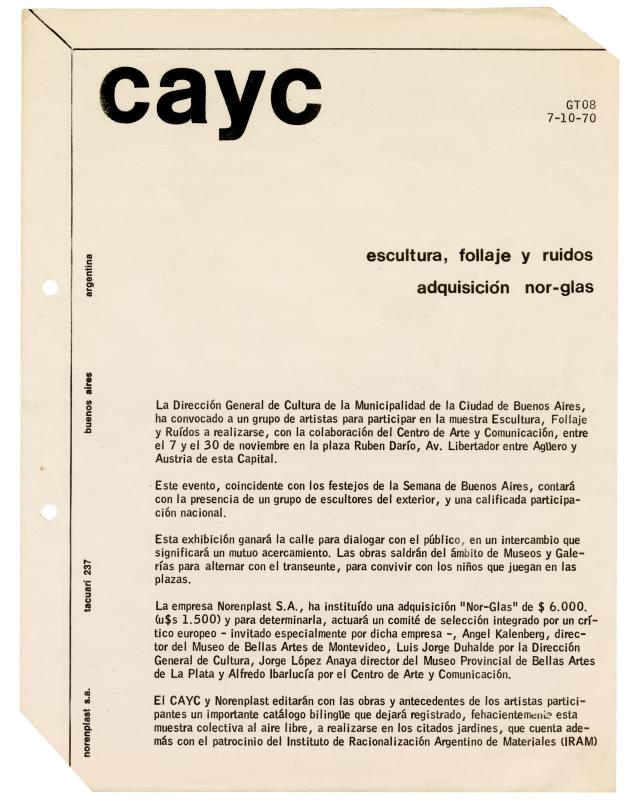
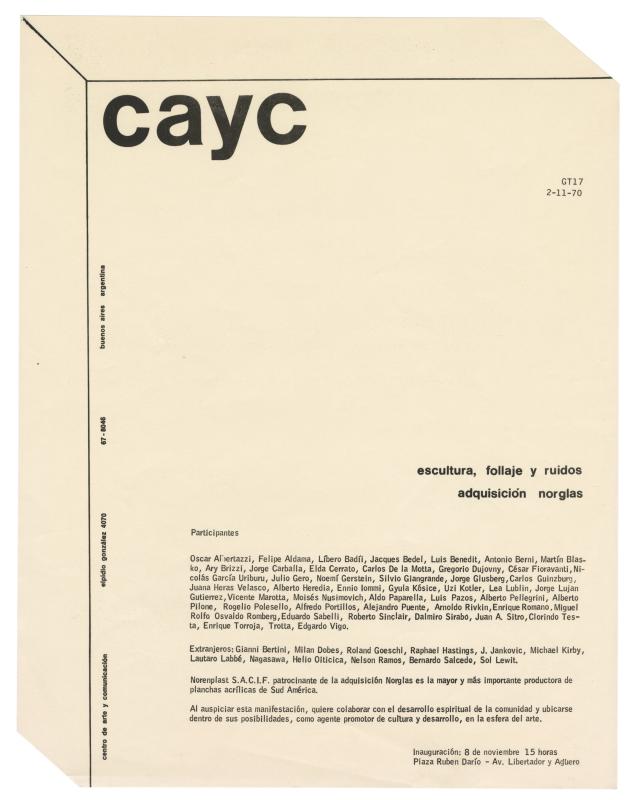
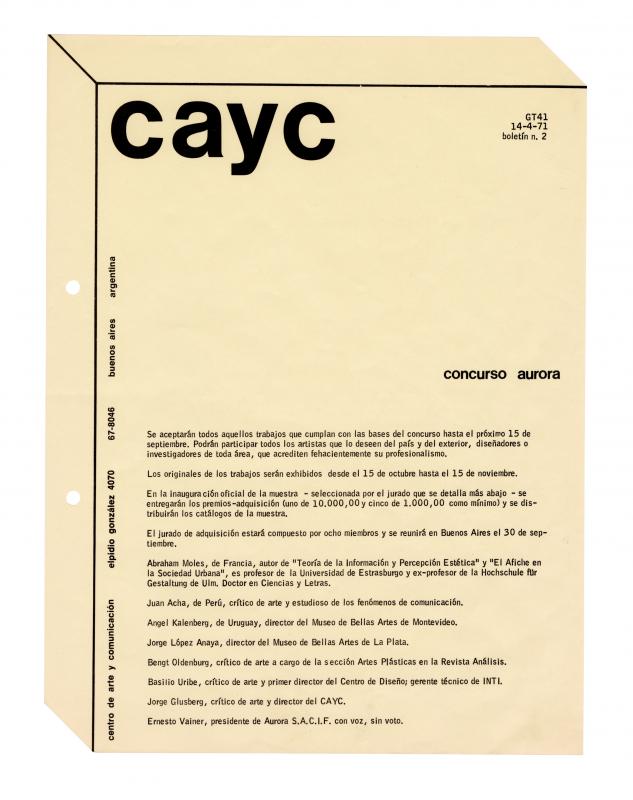
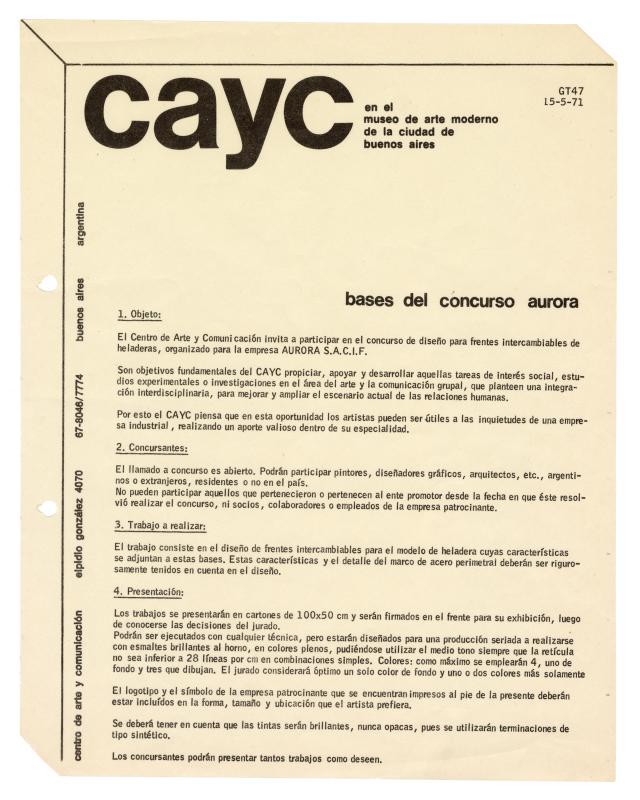
The involvement of Dr. Mitelpunk, a psychiatrist, in the group work demonstrated the social aspect of the process of invention, as had happened with Cooper and the Grupo de los Trece (GT-202; doc. no. 1478808, GT-208; doc. no. 1478809, GT-213-A; doc. no. 1476423, GT-252; doc. no. 1478798). The CAYC created initiatives like this seminar (GT-279, doc. no. 1478830, GT-280; doc. no. 1478825, GT-281; doc. no. 1478826, GT-282-282/1; doc. no. 1478827) as opportunities for exposure and exchange, which contributed to the development of disciplines that were thought to have been ignored or overlooked in Argentina during the 1970s. Courses, exhibitions, and competitions of this type frequently enjoyed the support of companies engaged in the production and marketing of industrial products. A case in point was the involvement of Norenplast S.A. (a supplier of plastic materials) in the exhibition Escultura, follaje y ruidos in 1970 (GT-08; doc. no. 1477957, GT-17; doc. no. 1477959), or the competition organized by the Aurora home appliance company in 1971 (GT-41; doc. no. 1478063, GT-42; doc. no. 1478064, GT-47; doc. no. 1478075). Another was Glusberg’s firm, Modulor S.A., which sold lighting fixtures.