Ever since it was founded, the CAYC (Centro de Arte y Comunicación), helmed by the cultural promoter, artist, and businessman Jorge Glusberg, was intended as an interdisciplinary space where an experimental art movement could flourish. The establishment of collaborative networks connecting local and international artists and critics played an important role in this process. The exhibitions shone a light on these exchanges, in which overviews of trends or individual artists provided an introduction to the innovations of international contemporary art and made Argentine and Latin American artists better known on the global scene.
Architecture and design were both basic components of the CAYC’s interdisciplinary approach from the very beginning. In its early years, the center became affiliated with the Fundación de Investigación Interdisciplinaria (Foundation for Interdisciplinary Research), an organization that included a group of dissident professors from the Facultad de Arquitectura y Ciencias Exactas at the Universidad de Buenos Aires following the occupation of universities after the coup d’état orchestrated by General Onganía in 1966. This connection to architecture left its mark on various aspects of the CAYC’s operations, such as the description of many of its initiatives as “projects;” the use of heliographic copies in its exhibitions (a technique usually used for copying building plans); the center’s collaboration with the industrial sector in exhibitions and contests; and the presence of several artist-architects among the members of the Grupo de los Trece.
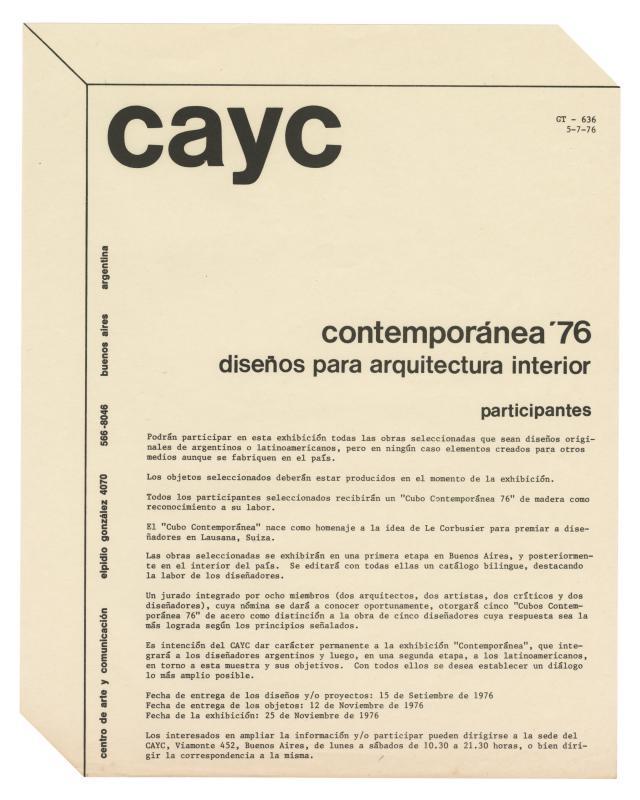
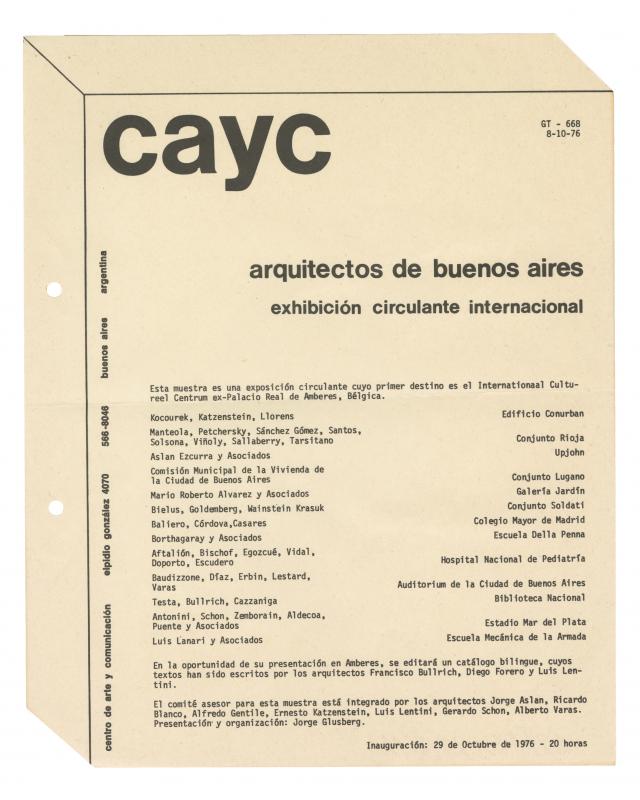
In the mid-1970s—when the censorship and repression imposed by the military dictatorship (1976–83) made it impossible to produce any of the explicitly political works that had been so common since 1972—the CAYC organized activities such as Contemporánea 76 (GT-636; doc. no. 1477205), Arquitectos de Buenos Aires (GT-668; doc. no. 1477400), and the Coloquios Latinoamericanos de Arquitectura (1976). These events contributed to the evolution of disciplines that were thought to have been ignored in Argentina in those days and that referred to the contemporary circumstances a little less directly. It should be noted, however, that since May 1977, the CAYC’s newsletters mentioned the collaboration of the Department of Cultural Affairs at the Ministry of Foreign Relations and Culture of the Republic of Argentina in the organization of activities, an “official” touch that was perhaps extenuating and timely.
This newsletter announces the presentation—on the occasion of the exhibition Arquitectura italiana contemporánea—of two parallel video programs, one at the Ministry’s National Exhibition Rooms and the other at the CAYC, by Carlodalatri, the architect, and Jorge Glusberg, director of the CAYC. The exhibition presented the latest news in Italian architectural circles concerning urban growth and the programs developed for the construction of urban models to be applied on a massive scale.
Paolo Carlodalatri graduated from La Sapienza di Roma with a degree in architecture, then took postgraduate courses at the Universidad de Buenos Aires after emigrating to Argentina. He has worked in urban planning and the construction of industrial complexes, and in the construction of machines and installations.